
What is a BESC/ECTN Certificate?
The BESC or ECTN certificate is a mandatory document for exporters and freight forwarders sending cargo to specific African nations. This certificate helps prevent cargo loss, smuggling, and tax evasion by providing detailed shipment information including origin, destination, and transit points.
Why is the BESC/ECTN Certificate Important?
Obtaining this certificate is crucial for:
- Ensuring compliance with destination country import regulations
- Facilitating faster customs clearance
- Avoiding penalties and delivery delays
Does your shipment need a BESC?
Before starting the application, confirm whether your shipment requires a BESC or ECTN certificate based on destination country regulations. Consult with your shipping agent for current requirements.
How to get an ECTN certificate, step by step
1. Find the name your destination uses
The ECTN is the same kind of document everywhere, but each country prints it under its own name. Use the name printed on the destination's certificate when you apply:
| Name on the certificate | Destinations |
|---|---|
| BESC | Benin, Cameroon, Chad, Mali, Niger, Togo, Burundi, Guinea, Central African Republic, Liberia |
| BSC | Senegal, Ivory Coast, Madagascar |
| ECTN | Burkina Faso, Djibouti, Republic of Congo, Somalia, South Sudan, Equatorial Guinea, Gambia |
| Other names | CTN for Sierra Leone, CEE for Guinea-Bissau, SPN for Ghana, ARCCLA for Angola, BIETC for Gabon, FERI for DR Congo, ACD for Sudan and Kenya, ACID for Egypt |
2. File for the final destination, not only the port
Mali, Niger, Burkina Faso, Chad, the Central African Republic and Burundi have no seaport. Their cargo is discharged in a coastal country and travels on by road. The certificate follows the final destination: cargo for Bamako discharged at Dakar still needs the Mali BESC. Tell the filer both the port of discharge and the final destination.
3. Check when the certificate is due
Each country anchors its deadline to a different moment, and that decides when you have to start:
- At loading: the Kenya ACD reference code is obtained at the point of loading and goes into the Goods Description of the Bill of Lading.
- Before the vessel arrives: the Mali BESC has to be validated before the vessel reaches the port of discharge.
The safe rule everywhere is to open the file when the booking is confirmed. A draft Bill of Lading is usually enough to start.
4. Prepare the documents
The core set is the same almost everywhere: Bill of Lading, commercial invoice, freight invoice (when freight is not on the invoice), export declaration and packing list. Some destinations add their own step:
- Angola: the importer's import licence, the D.U.
- Madagascar: both the shipper and the consignee must be registered on GasyNet's BSC system before a draft can be issued.
- Egypt: the importer registers the ACID number on NAFEZA and passes it to the exporter, who must be registered on CargoX.
- Kenya: the ACD is filed from the exporter's own KRA account; a forwarder files as a sub-user of that account.
5. Check the draft, then validate
Check the draft against the Bill of Lading and the invoice before it is validated: weights, package counts, HS codes, parties and the port of discharge. Corrections at draft stage are part of the normal process; many authorities charge for changes after validation.
6. Put the number where it is required
Some destinations want the certificate number on the Bill of Lading, others do not. Kenya requires the ACD code in the Goods Description; for Mali the authority does not require the BESC number on the Master Bill of Lading, although some carriers ask for it. Check with your carrier before the Bill of Lading is issued.
Questions about getting an ECTN
Can I get an ECTN after the vessel has sailed?
Sometimes, at a higher cost. Cameroon has a regularisation ECTN at its port desk, and a late online request stays pending until the penalty is paid. Mali refuses a customs declaration without a BESC at the border and sends the cargo back to the port to be regularised. Filing on time is always cheaper.
Do I need one ECTN per container?
One certificate covers one Bill of Lading, however many containers it lists. For LCL cargo some destinations need one filing per House Bill of Lading, as Kenya does.
Can I apply for an ECTN myself?
It depends on the destination. In Kenya the exporter files from its own account; in Burkina Faso only forwarders create the ECTN in the shippers' council's application. See who can file an ECTN, country by country.
Which documents do you need?
Collect the following documents and shipment details:
- Bill of Lading (BOL)
- Commercial Invoice
- Freight Invoice (if applicable)
- Export Customs Declaration
- Packing List
Ensure all documents are accurate and fully detailed to prevent application delays.
How do you submit the application?
Submit prepared documents to the expert team via online submission, which is efficient and environmentally friendly. Enter all information correctly to prevent processing delays.
How much does it cost?
Certificate costs vary by destination country and cargo volume, typically calculated on container count or gross weight. Payment methods include bank transfers and online platforms.
When do you receive the certificate?
After processing and payment, the authorized agent issues your certificate electronically. Print and present this document with your shipping materials upon arrival at the destination port.
Conclusion
Following these straightforward steps while carefully preparing documentation ensures smooth compliance with shipping regulations to African countries. Success depends on attention to detail and selecting an appropriate agent.
Official sources
Official Benin BESC sources
The Benin BESC is required by Order No. 077/MIT/DC/SGM/PAC/CTJ/SA of 10 August 2016.
accessed
Top 3 causes of Benin BESC rejection
- BESC number not indicated on the Bill of Lading.
- Commercial invoice does not state the Freight amount separately.
- Container seal number does not match across the BL and Certificate.
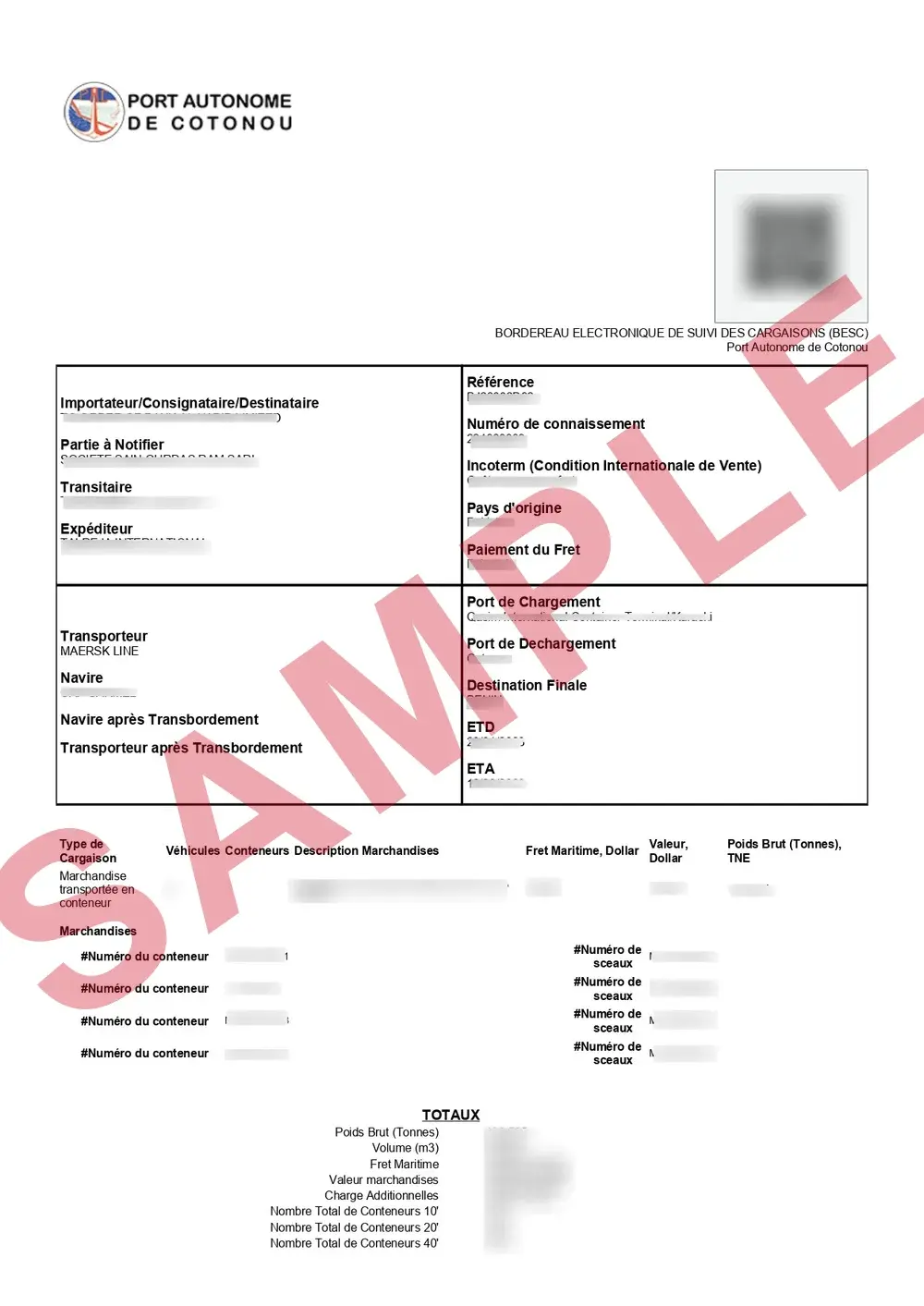
Official BESC Document Sample
Verify the layout, stamps, and BESC customs format of a validated Benin loading certificate:
Official Cameroon BESC sources
The Cameroon BESC is issued under the Cameroon National Shippers’ Council (CNCC).
- Cameroon Tribune (18 Jun 2026): CNCC suspends the BESC for transit goods (communiqué of 15 June 2026)
- Journal du Cameroun (22 Sep 2026): export BESC late-submission window extended to 15 days
accessed
Top 3 causes of Cameroon BESC rejection
- Missing or blurred SGS certification stamp on the Commercial Invoice.
- Missing freight breakdown (sea freight value must be clearly declared separately).
- Incorrect HS Code (must be 4 to 8 digits matching Cameroon customs tariffs).
Case study: Cameroon BESC: The 48-Hour Rule and What a One-Day Delay Really Costs
Chad BESC: official notices
The Chad BESC is required by the Chad shippers’ council; the Cameroon transit rule is set by Cameroon’s shippers’ council (CNCC).
- Investir au Cameroun (22 Jun 2026): CNCC suspends the BESC for transit cargo on the Douala–N’Djamena and Douala–Bangui corridors
- ANTASER notices: Chad BESC mandatory since January 2013
accessed
Top 3 causes of Chad BESC problems
- The Bill of Lading has no shipped-on-board date.
- The commercial invoice is missing, has no Incoterm, or does not state Chad as the destination.
- Package types differ between the Bill of Lading and the invoice (pallets on one, boxes on the other).