
ACD Full Form & Meaning in Shipping
Advance Cargo Declaration
What does ACD stand for?
ACD stands for Advance Cargo Declaration.
What is ACD?
A customs and port-security filing lodged at origin for sea cargo to Sudan, Yemen and Kenya. It records the shipper, consignee, cargo, HS codes, weights and values under one reference quoted on the Bill of Lading, so the destination authority can check the shipment before the vessel arrives.
Who regulates ACD?
The destination authority issues and validates it: the Sudan Customs Authority in Sudan and the Kenya Revenue Authority (KRA) in Kenya. In Yemen the ACD requirement was issued by the Counter Terrorism Service.
What is the ACD definition in shipping?
In shipping and customs, ACD means Advance Cargo Declaration: a filing lodged at origin that records the shipper, consignee, cargo, HS codes, weights and values under one reference quoted on the Bill of Lading. Outside freight the same letters usually mean Automatic Call Distribution, the call-centre routing system, which is a different term.
When is the ACD due?
It depends on the country. Yemen takes the ACD before the cargo is loaded. Sudan requires it no later than 24 hours before the vessel arrives at Port Sudan, and after that cut-off no application can be filed. In Kenya, the Kenya Revenue Authority's ACD platform (acd.kra.go.ke, live since 3 August 2026) covers containerised cargo for Kenyan ports: the exporter obtains the ACD reference at the point of loading by uploading the draft Bill of Lading, commercial invoice, freight invoice and export declaration, and the reference is endorsed on the Bill of Lading.
Is ACD the same as ACID?
No. ACID, the Advance Cargo Information Declaration, is Egypt's NAFEZA number and is obtained by the Egyptian importer. The ACD is the Advance Cargo Declaration filed at origin for Sudan, Yemen and Kenya.
Is ACD the same as ECTN?
They belong to the same family of origin-side electronic filings, and the Kenya Revenue Authority describes the ACD as known internationally as CTN, ECTN, BSC or BESC. The ACD leans toward security and customs risk screening; the ECTN mainly serves freight-value verification and trade statistics.
What is an ACD number?
The ACD number is the reference code the destination platform issues for one shipment: one code per Bill of Lading, and in Kenya one per House Bill of Lading for LCL cargo. It is printed on the Bill of Lading; in Kenya it goes in the Goods Description section.
How do I check an ACD number?
For Kenya, KRA's verification page, acd.kra.go.ke/verify, checks the ACD status by Bill of Lading number. For Sudan, the ACD Sudan platform (acdsudan.com) issues the certificate; we found no public check page there on 15 October 2026, so ask the party that filed it.
Which documents does an ACD need? Is there a form?
There is no paper form: the ACD is filed online on the destination platform. Kenya asks for the carrier-issued draft Bill of Lading, the final commercial invoice, the freight invoice and the official export declaration. Sudan also needs a certificate of origin and a packing list; Yemen a certificate of origin and a freight invoice.
Which countries require ACD?
These destinations require the ACD certificate: Sudan, Yemen, and Kenya.
Official sources
Official Sudan ACD sources
The Sudan ACD is issued on the official ACD Sudan platform for the Sudan Customs Authority. Support: info@acdsudan.com, operations@acdsudan.com.
- ACD Sudan official platform: acdsudan.com
- ACD Sudan: About ACD (documents, responsibility, Bill of Lading)
- ACD Sudan: fees and payments (tariff updated May 2026)
- Maersk advisory: ACD requirements for shipments to Sudan (11 December 2025)
accessed
Top 3 causes of Sudan ACD rejection
- Missing Certificate of Origin or incorrect chamber of commerce stamp.
- ACD number not declared on the vessel manifest.
- Blurred or illegible scans of loading documents.
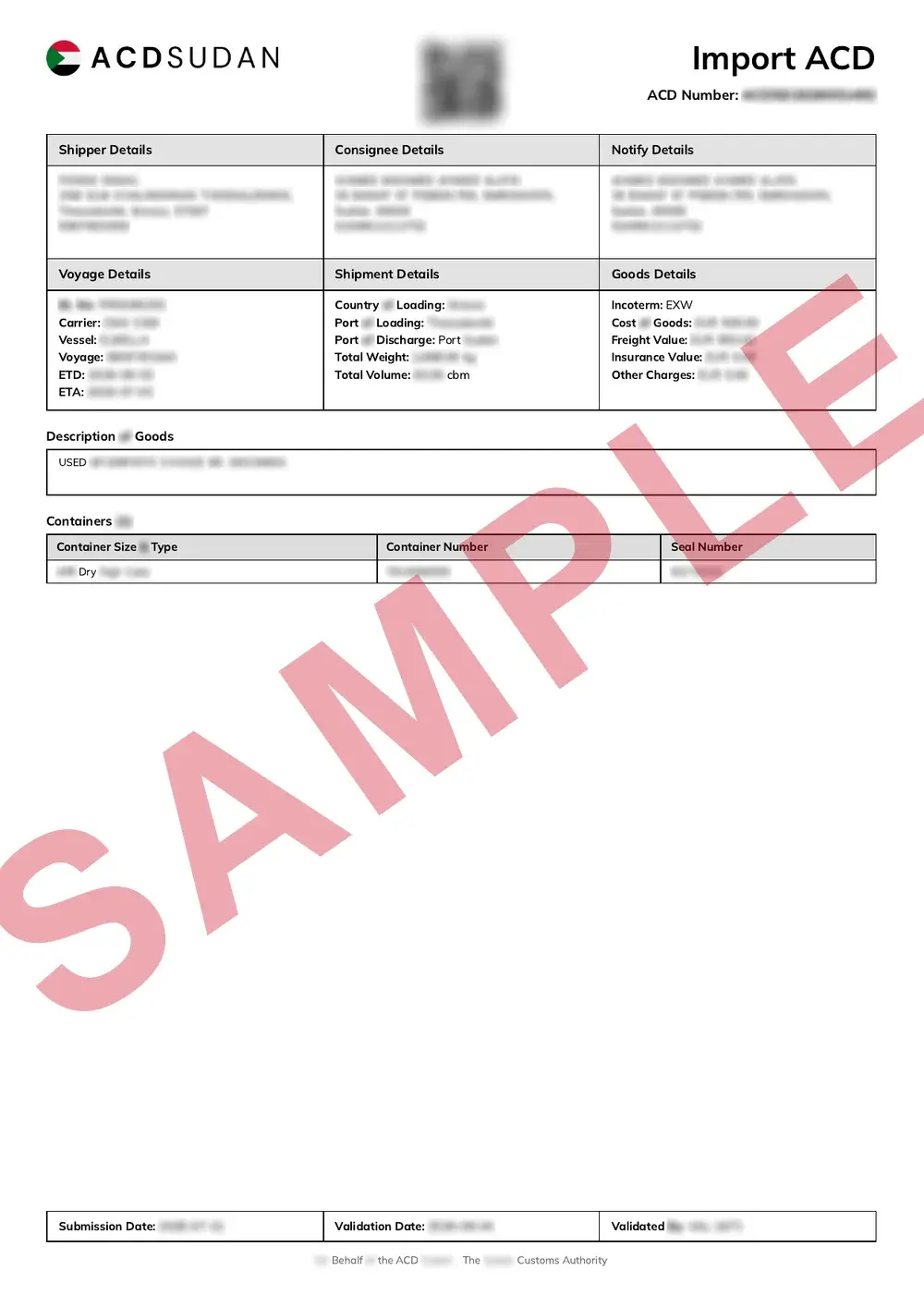
Official ACD Document Sample
Verify the layout, stamps, and ACD customs format of a validated Sudan loading certificate:
Yemen ACD sources
The Yemen ACD was introduced by Yemen’s Ministry of Transport and enforced for containers by the Counter Terrorism Service-Yemen.
accessed
Top 3 causes of Yemen ACD rejection
- Cargo description mismatch between the Bill of Lading and the Commercial Invoice.
- Missing or inconsistent shipper/consignee details versus the declared manifest.
- ACD reference not obtained before loading at the origin port.
Official Kenya ACD sources
The Kenya ACD is run by the Kenya Revenue Authority (Commissioner for Customs and Border Control).
- KRA public notice: Advance Cargo Declaration (ACD) Platform for Containerized Cargo (14 July 2026)
- KRA ACD platform and FAQ: acd.kra.go.ke
- KRA ACD verification by Bill of Lading number: acd.kra.go.ke/verify
accessed
Top 3 causes of Kenya ACD problems
- One of the four documents is missing: the KRA platform generates the code only after the draft Bill of Lading, commercial invoice, freight invoice and export declaration are all uploaded.
- Parties, cargo, weights or values differ between the documents; the shipper, consignee, HS codes and freight amount must read the same on all four.
- The ACD code is not endorsed on the Bill of Lading before the shipment proceeds to Kenya.
Illustrative layout (not a real document)
A standard verified ACD contains key cargo parameters that customs systems scan: