

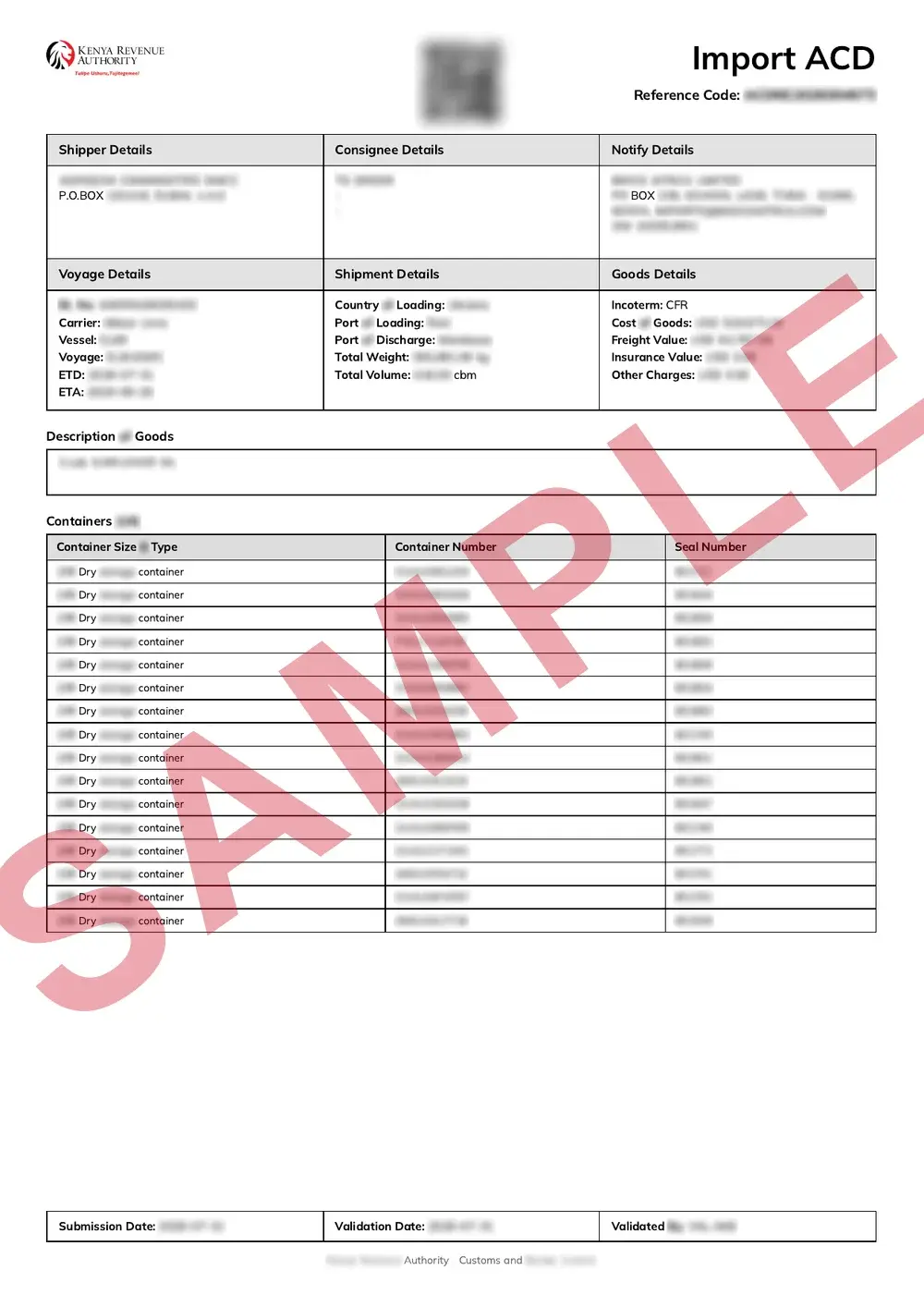









What is Kenya ACD?
ACD stands for Advance Cargo Declaration. In Kenya it is the Kenya Revenue Authority’s digital pre-arrival cargo system for containerised cargo, run on acd.kra.go.ke since 3 August 2026. The exporter uploads the draft Bill of Lading, commercial invoice, freight invoice and export declaration at the point of loading; the platform generates an ACD reference code, which is endorsed on the Bill of Lading before the shipment proceeds to a Kenyan port. Cargo in transit is exempt only when the Bill of Lading shows both a final destination and a consignee outside Kenya.
New to the ACD? Read ACD meaning in shipping, and CTN meaning in shipping for the cargo tracking note that 30 African and Middle East destinations ask for in one form or another.
Other names for the Kenya ACD
One instrument, several names. For Kenya the filing is the ACD — Advance Cargo Declaration. The same certificate is also referred to as ECTN (Electronic Cargo Tracking Note), cargo tracking note, and advance cargo declaration, and a request for one is a request for the other. If your importer or your carrier has asked for a name that is not on this page, send it to us with the Bill of Lading and we will confirm which filing they mean.
Which ports need the Kenya ACD?
The Kenya ACD covers all containerised cargo destined for Kenyan ports, Mombasa being the main one: FCL, LCL, consolidated and groupage. For LCL each House Bill of Lading needs its own ACD, with the carrier’s Master Bill of Lading uploaded too. Transit cargo is exempt only when the Bill of Lading shows both a final destination and a consignee outside Kenya and clearly identifies the transit; if the consignee is in Kenya or Kenya is the final destination, the ACD is required even if the cargo moves on.
Official Kenya ACD sources
The Kenya ACD is run by the Kenya Revenue Authority (Commissioner for Customs and Border Control).
- KRA public notice: Advance Cargo Declaration (ACD) Platform for Containerized Cargo (14 July 2026)
- KRA ACD platform and FAQ: acd.kra.go.ke
- KRA ACD verification by Bill of Lading number: acd.kra.go.ke/verify
accessed
When must the Kenya ACD be issued?
The Kenya ACD is obtained at the point of loading. The KRA platform generates the reference code once the draft Bill of Lading, commercial invoice, freight invoice and export declaration are uploaded, and the code must be endorsed on the Bill of Lading before the shipment proceeds to a Kenyan port. Start as soon as the draft Bill of Lading exists; a draft is enough to file.
Who files the Kenya ACD?
The shipper or exporter shown on the Bill of Lading obtains the ACD reference code, through its own registered account on acd.kra.go.ke. A freight forwarder cannot file from its own account; it is added as a sub-user to the exporter’s account and files from there. Shipping lines must show the approved code on the final Bill of Lading before loading. The sales terms decide who pays, not who files.
How to get an ACD for Kenya
- ▪Prepare the four documents KRA asks for: the draft Bill of Lading, the commercial invoice, the freight invoice and the export declaration.
- ▪Upload them on the KRA ACD platform, acd.kra.go.ke, from the exporter’s own registered account at the point of loading. A forwarder, or we, can file as a sub-user on that account.
- ▪The platform generates the ACD reference code once the documents are uploaded.
- ▪Endorse the ACD reference code on the Bill of Lading before the shipment proceeds to a Kenyan port.
Kenya ACD: validity and amendments
One ACD reference code covers one Bill of Lading; for LCL, one House Bill of Lading. The requirement applies by the Bill of Lading’s issue date: a Bill of Lading issued on or after 3 August 2026 needs the code. If the Bill of Lading is amended after the ACD is issued, the exporter updates the ACD record and the same code stays valid.
What happens without a valid Kenya ACD?
Cargo arriving without a validated ACD is generally not released at Mombasa, Lamu or Kisumu: customs clearance delays, storage and demurrage accruing daily, and regulatory fines until a valid certificate is presented. The demurrage is often the larger of the two numbers, and it is the one that grows while the paperwork is corrected.
What the Kenya ACD costs
KRA charges nothing for the ACD at present: no registration, application, validation, certificate or amendment fee, and no per-container tariff. KRA has said it may introduce a tariff later. Our service fee for preparing and filing the declaration is separate and is shown before anything is filed.
Is the Kenya ACD Mandatory?
Yes. Since 3 August 2026 the Kenya ACD is mandatory for all containerised cargo destined for Kenyan ports. The reference code comes from the Kenya Revenue Authority’s platform, acd.kra.go.ke, and is endorsed on the Bill of Lading.
In What Order Is the Kenya ACD Code Obtained?
The clock starts when four documents are uploaded to the KRA platform: it generates the code only after the draft Bill of Lading, commercial invoice, freight invoice and export declaration are all in. Before that, the shipper on the Bill of Lading needs its acd.kra.go.ke account ready. Once the code exists, it goes on the Bill of Lading.
Delays sit in accounts and documents: a forwarder not yet added as a sub-user, an export declaration still in draft, only a proforma invoice, or parties, HS codes and freight amounts that differ across the four. KRA’s limit is that the code is on the Bill of Lading before the shipment proceeds to a Kenyan port.
Which Kenya ACD Documents Can Be Drafts?
Only the Bill of Lading. The carrier-issued draft is enough. The commercial invoice must be the final invoice for the sale to the Kenyan importer, so a proforma is not accepted. The customs export declaration must be official and final, so its draft is not accepted either.
Kenya ACD and the Bill of Lading Issue Date
KRA’s rule looks at the Bill of Lading’s issue date: a Bill of Lading issued on or after 3 August 2026 needs the code. When you check a shipment for Kenya against that date, use the issue date and not the vessel’s movement.
Does Non-Containerised Cargo Need a Kenya ACD?
The KRA notice and platform speak of containerised cargo: FCL, LCL, consolidated and groupage. Our sources give no separate statement on other cargo. So do not assume non-containerised cargo to Kenya falls outside the scope: ask us for your shipment before you upload anything to KRA.
How Many Kenya ACD Codes for LCL and Consolidated Cargo?
One per House Bill of Lading. Three House Bills of Lading under one Master take three ACDs, with the carrier’s Master Bill of Lading uploaded too. Filing on the KRA platform runs through the exporter shown on the Bill of Lading, so check who the shipper is on each House Bill of Lading.
What Counts as Freight Evidence for the Kenya ACD?
KRA takes the freight invoice or other shipment-specific freight evidence. What decides is that the document belongs to that shipment. The freight amount on it has to agree with the other three documents uploaded to the KRA platform.
Amending the Bill of Lading After the Kenya ACD Is Issued
No new code is needed: the exporter updates the ACD record and the same code stays valid. KRA charges no amendment fee at present. Since the exporter makes the update on its account, a forwarder holding the correction should pass it on so the KRA record matches the Bill of Lading.
Transit Through Mombasa: How the Bill of Lading Should Read
The Bill of Lading decides this. For no ACD to be needed, KRA wants it to show both a final destination and a consignee outside Kenya and to identify the transit clearly. A consignee in Kenya, or Kenya as the final destination, brings the ACD back even if the cargo moves on. Check the wording before the Bill of Lading is issued.
Shipping to Kenya from Turkey
The exporter in Turkey shown on the Bill of Lading files through its own KRA account; a Turkish forwarder works as a sub-user on that account. Have four documents ready at the point of loading: the carrier’s draft Bill of Lading, the final invoice to the Kenyan importer, the freight evidence and the official final Turkish export declaration.
Why File Through GetCTN
We file as a sub-user on the exporter’s own acd.kra.go.ke account, the route KRA allows, after checking that the shipper, consignee, HS codes and freight amount read the same on all four documents. KRA charges nothing at present; our service fee is separate and shown before filing. GetCTN is a private company and not part of KRA.
ACD Kenya questions
What is the ACD for Kenya?
ACD stands for Advance Cargo Declaration. In Kenya it is the Kenya Revenue Authority’s pre-arrival cargo system for containerised cargo: the exporter obtains an ACD reference code on acd.kra.go.ke at the point of loading and endorses it on the Bill of Lading.
Since when is the Kenya ACD mandatory?
Since 3 August 2026. KRA announced the platform in a public notice dated 14 July 2026; it applies to all containerised cargo destined for Kenyan ports.
How do I get an ACD for Kenya?
Upload the draft Bill of Lading, commercial invoice, freight invoice and export declaration on acd.kra.go.ke at the point of loading. The platform generates the ACD reference code, which you endorse on the Bill of Lading. We can prepare and file it for you.
Which documents does the Kenya ACD need?
Four: the carrier-issued draft Bill of Lading, the final commercial invoice for the sale to the Kenyan importer (a proforma is not accepted), the freight invoice or other shipment-specific freight evidence, and the official final customs export declaration (a draft is not accepted). The parties, cargo, weights, values and freight must match across them.
Must the ACD number be on the Bill of Lading?
Yes. KRA requires the ACD reference code to be endorsed on the Bill of Lading before the shipment proceeds to a Kenyan port.
Is the Kenya ACD needed for transit cargo through Mombasa?
Not always. According to KRA, no ACD is needed when the Bill of Lading shows both a final destination and a consignee outside Kenya and clearly identifies the transit. If the consignee is in Kenya or Kenya is the final destination, the ACD is required even if the cargo moves on.
How do I check a Kenya ACD?
KRA’s verification page, acd.kra.go.ke/verify, checks the ACD status by Bill of Lading number. Carriers use it to confirm a shipment is covered before loading.
Is there a fee for the Kenya ACD?
Not from KRA at present: no registration, application, validation, certificate or amendment fee. KRA may introduce a tariff later. A filing service such as ours charges its own fee.
How long does the Kenya ACD take?
KRA’s formal review time is 24 hours; in practice applications are usually processed within 2 to 3 hours, and straightforward ones in about 15 minutes. Submit well ahead of loading.
Where is the ACD number written on the Bill of Lading?
In the Goods Description (Cargo Description) section. No separate stamp or attachment is needed; the shipping line adds the code there before issuing the final Bill of Lading.
Who do I contact at KRA about the ACD?
KRA lists operations@acd.kra.go.ke and info@acd.kra.go.ke for ACD enquiries, and acd.kra.go.ke for guidance on the process.