
Overview
The ACD — Advance Cargo Declaration — is the electronic cargo tracking note required for sea shipments to Kenya, which discharge at Mombasa. It ties the shipper, consignee, cargo and freight values on your Bill of Lading to a single reference that customs can reconcile before the cargo is worked. It is obtained at the point of loading: the KRA platform generates the code once the four documents are uploaded, and the code must be on the Bill of Lading before the shipment proceeds to a Kenyan port.
Discharge ports
Required documents
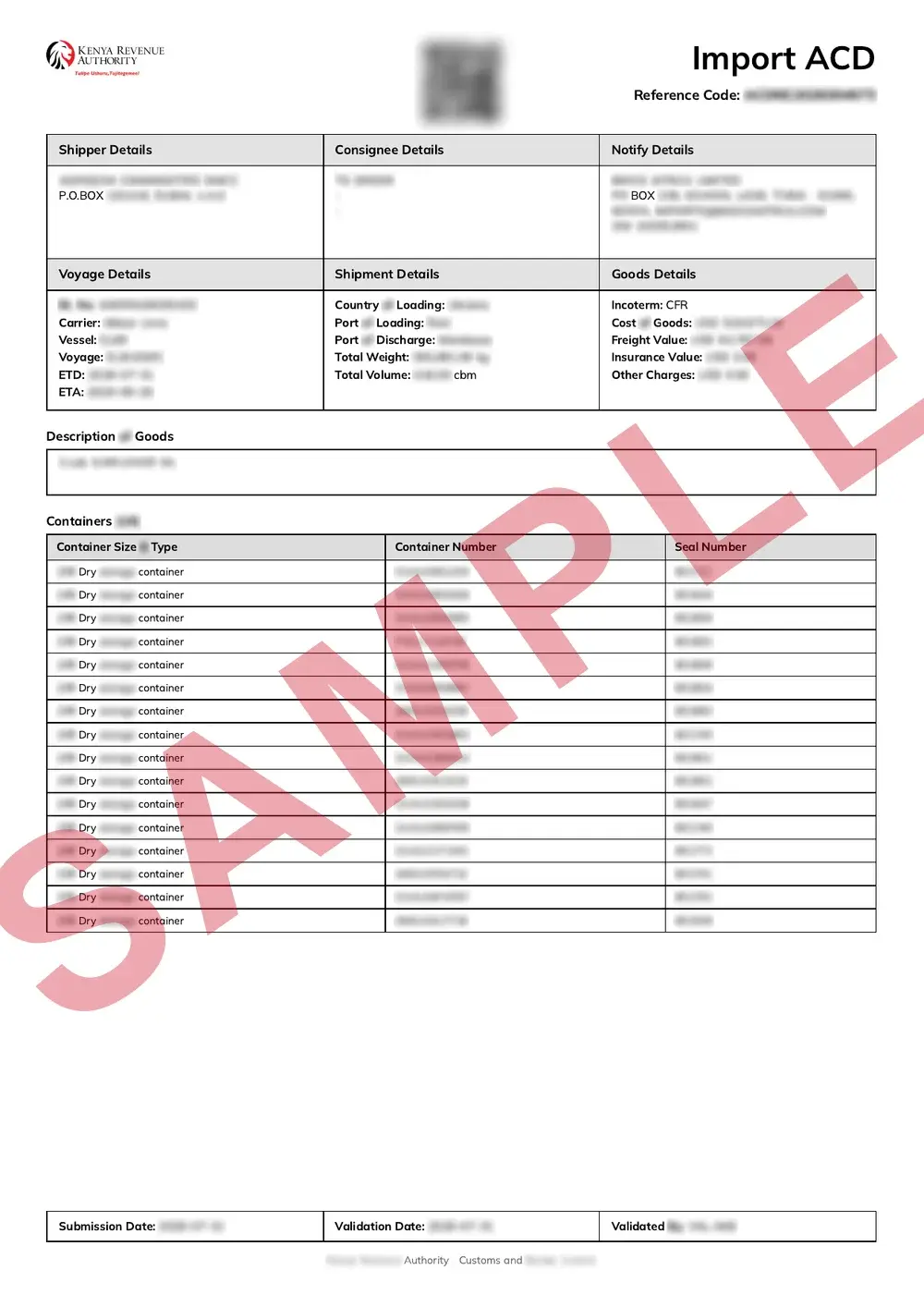
Official ACD Document Sample
Verify the layout, stamps, and ACD customs format of a validated Kenya loading certificate:
Application process
- 1SubmitSend your Bill of Lading and Commercial Invoice, with the Freight Invoice if freight is not shown on the commercial invoice.
- 2Draft & invoiceWe prepare a draft certificate and a fixed-price invoice within 1 hour on average.
- 3ApproveYou review the draft and confirm every detail before anything is filed.
- 4PaymentThe fixed-price invoice is settled so the file can go forward for validation.
- 5ValidateThe certificate is validated and the final ACD number is confirmed.
Timeline
| Step | Duration |
|---|---|
| Submit documents | Your action |
| Draft & invoice | 1 hour on average |
| Approve draft | Your action |
| Payment | Your action |
Special rules & HS codes
Transit cargo
Transit: according to KRA, no ACD is needed when the Bill of Lading shows both a final destination and a consignee outside Kenya and clearly identifies the transit movement. If the consignee is in Kenya or Kenya is the final destination, the ACD is required even if the cargo moves on.
Who files
The shipper or exporter shown on the Bill of Lading obtains the ACD reference code through its own registered account on acd.kra.go.ke. A freight forwarder cannot file from its own account; it is added as a sub-user to the exporter’s account and files from there.
Where the code goes
In the Goods Description (Cargo Description) section of the Bill of Lading. No separate stamp or attachment is needed; the shipping line adds the code there before issuing the final Bill of Lading.
Scope and start date
All containerised cargo destined for Kenyan ports: FCL, LCL, consolidated and groupage. For LCL each House Bill of Lading needs its own ACD. The requirement applies by the Bill of Lading’s issue date: a Bill of Lading issued on or after 3 August 2026 needs the code.
Fees
KRA charges nothing for the ACD at present: no registration, application, validation, certificate or amendment fee. KRA has said it may introduce a tariff later. Our service fee for preparing and filing the declaration is separate and is shown before anything is filed.
Checking an ACD number
KRA’s verification page, acd.kra.go.ke/verify, checks the ACD status by Bill of Lading number. Carriers use it to confirm a shipment is covered before loading.
Official sources
Official Kenya ACD sources
The Kenya ACD is run by the Kenya Revenue Authority (Commissioner for Customs and Border Control).
- KRA public notice: Advance Cargo Declaration (ACD) Platform for Containerized Cargo (14 July 2026)
- KRA ACD platform and FAQ: acd.kra.go.ke
- KRA ACD verification by Bill of Lading number: acd.kra.go.ke/verify
accessed
Top 3 causes of Kenya ACD problems
- One of the four documents is missing: the KRA platform generates the code only after the draft Bill of Lading, commercial invoice, freight invoice and export declaration are all uploaded.
- Parties, cargo, weights or values differ between the documents; the shipper, consignee, HS codes and freight amount must read the same on all four.
- The ACD code is not endorsed on the Bill of Lading before the shipment proceeds to Kenya.
Frequently asked questions
Ready to get your ACD?
Send your Bill of Lading and get your draft certificate today — fast, transparent, compliant.