









What is the DR Congo FERI (DRC FERI, DRC ECTN)?
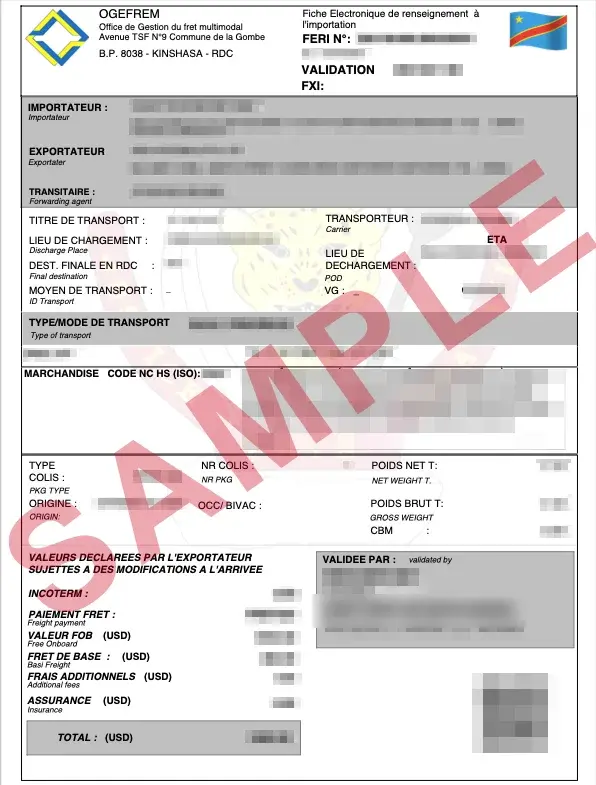
The DR Congo FERI, also called the DRC FERI or the Kongo FERI, is the import tracking note of OGEFREM (Office de Gestion du Fret Multimodal), the DRC shippers’ council created in 1980 and extended to all transport modes by decree 09/63 of 3 December 2009. Since the interministerial order N°008/CAB/VPM/MIN/TC/2019 of 22 January 2019, subscription of the FERI, of the Attestation de Destination (AD) for the overland leg and of the FERE for exports is compulsory, and ministerial order N°011 of the same day sets how OGEFREM manages and checks it. The DRC FERI follows the cargo from subscription and OGEFREM validation through loading and the sea passage to arrival at Matadi or Boma. Since 1 March 2023 the DR Congo FERI and the AD can be subscribed with any OGEFREM-approved agent at the place of loading.
The FERI is DR Congo’s form of the cargo tracking note; CTN meaning in shipping explains the document 30 African and Middle East destinations ask for in one form or another.
DR Congo FERI: Matadi, Boma and transit ports
The FERI is required for sea cargo discharged at Matadi or Boma for the Democratic Republic of the Congo. DR Congo (capital Kinshasa) is not the Republic of Congo (capital Brazzaville): cargo for Pointe-Noire needs the Republic of Congo ECTN instead. Tell us the port of discharge and final destination when you send the Bill of Lading.
Official DR Congo FERI sources
The DR Congo FERI is issued under OGEFREM (Office de Gestion du Fret Multimodal), Kinshasa. OGEFREM also issues the Attestation de Destination (AD) and the FERE for exports.
- OGEFREM: interministerial order of 22 January 2019 on the compulsory FERI, AD and FERE
- OGEFREM: FERI/FERE tracking — subscription, validation, loading, arrival
- OGEFREM: approved agents (mandataires); FERI and AD subscription open since 1 March 2023
accessed
DRC FERI: validated before the vessel arrives
The DR Congo FERI must be validated before the vessel arrives in the DRC. OGEFREM’s own sequence puts subscription and validation before loading, and agents ask for the DRC FERI to be validated about 5 days before arrival, so open the file as soon as the Bill of Lading details are settled.
Who files the DR Congo FERI
The shipper or the freight forwarder at the port of loading subscribes the DR Congo FERI, directly or through any OGEFREM-approved agent (mandataire); the importer in the DRC provides its FXI number.
How to get the DR Congo FERI, step by step
According to the customs regulations of DR Congo, every cargo shipment purchased from abroad and transported for commercial, business, diplomatic, or personal purposes requires a validated Loading Certificate:
- ▪Send the Bill of Lading (a draft opens the file), the commercial invoice with the Incoterm, the freight invoice if freight is not on the invoice, and the importer’s FXI number.
- ▪We check that the importer, the cargo, the freight and the values match across the documents and prepare the DR Congo FERI subscription.
- ▪The DRC FERI is subscribed online on the OGEFREM platform and validated by OGEFREM; you receive the draft to approve first.
- ▪The validated DR Congo FERI certificate is issued before the vessel reaches Matadi or Boma; for cargo moving on overland from a transit port, the AD is requested with it.
DR Congo FERI: validity and amendments
A validated FERI is issued against one shipment: one Bill of Lading, one vessel, one voyage, one consignee. It does not carry over to your next shipment and it carries no renewal date. If the shipment changes, the certificate has to change with it — and what can be amended after validation, and at what cost, is set by the destination authority. Corrections to the draft before filing cost nothing, which is why we send you the draft first.
What happens without a valid DR Congo FERI?
Cargo arriving without a validated FERI is generally not released at Matadi or Boma: customs clearance delays, storage and demurrage accruing daily, and regulatory fines until a valid certificate is presented. The demurrage is often the larger of the two numbers, and it is the one that grows while the paperwork is corrected.
What the DR Congo FERI costs
Two lines, quoted separately. The first is the statutory charge the destination authority sets for registering the certificate — it belongs to the authority, not to us, and it varies by destination and shipment profile. The second is our service fee for preparing the file, checking it against the published requirements, filing it and handling any query. Neither is a percentage of your cargo value. Both are fixed and shown before anything is filed, so the invoice you approve is the invoice you pay.
DR Congo FERI: latest notices and articles
Is the DR Congo FERI Mandatory?
Yes. The DR Congo FERI is mandatory for imports into the Democratic Republic of the Congo under the interministerial order of 22 January 2019. It is subscribed online on the OGEFREM platform, and cargo that reaches the DRC overland from a transit port also needs the AD.
How Long Does the DR Congo FERI Take?
The file opens when the draft Bill of Lading and the importer's FXI number arrive. The importer, cargo, freight and values are then checked across the documents, the draft comes to you for approval, the subscription goes in on the OGEFREM platform, and OGEFREM validates.
One of the waiting points sits in the DRC: the importer has to supply the FXI number. Unsettled Bill of Lading details, a commercial invoice without the Incoterm and freight missing from the invoice also hold the file. Where cargo moves on overland from a transit port, the AD is requested with the FERI.
The limits come from two places. OGEFREM's own sequence puts subscription and validation before loading, and agents ask for validation about 5 days before arrival at Matadi or Boma.
Which Numbers to Collect Before Filing a DR Congo FERI
Get the FXI number from the importer in the DRC before you apply. The document table lists a second number, the shipper's subscription card number (N° carte abonnement), which comes from the shipper's side. The FXI name appears again on the validated certificate: the FERI carries a number under VALIDATION FXI, and that is the reference to quote when the consignee or customs asks for it.
Where the FERI Number Goes on the Bill of Lading
A FERI number not written on the face of the Bill of Lading is a named rejection cause for DR Congo. Check the face of the document before the Bill of Lading is finalised.
Transit Ports for DR Congo: Dar es Salaam, Mombasa and Durban
When cargo enters the DRC overland from a transit port, the FERI is not enough on its own: the overland leg also needs the Attestation de Destination (AD). Our sources name Dar es Salaam, Mombasa, Durban and Pointe-Noire as examples of such ports. The FERI and the AD can both be subscribed with an OGEFREM-approved agent at the place of loading. State the route and the final destination when you apply.
No OGEFREM-Approved Agent at Your Place of Loading
Since 1 March 2023, the FERI and the AD can be subscribed with any OGEFREM-approved agent (mandataire) at the place of loading. Shippers in a zone with no approved agent apply through OGEFREM's Antwerp office. OGEFREM publishes the list of approved agents on its site.
Draft FERI and Validated FERI: What Is the Difference?
The draft comes out of a file opened on the draft Bill of Lading and is sent to you for approval. The validated FERI has passed OGEFREM's check and carries the VALIDATION FXI field. Approving the draft does not replace OGEFREM's validation, and validation is what agents ask to see before arrival at Matadi or Boma.
OGEFREM Tracking and the FERE for Exports
OGEFREM's tracking runs from subscription and validation through loading and the sea passage to arrival at Matadi or Boma. The same tracking service covers the FERE, the OGEFREM document for exports from the DRC. The FERI covers imports and the FERE covers exports, and both rest on the interministerial order of 22 January 2019.
Regularising a FERI Inside the DRC
Regularisation inside the DRC goes through the OCC (Office Congolais de Contrôle), which is separate from the work of an OGEFREM-approved agent at the place of loading. Cargo that arrives without a FERI is held until one is issued, with storage and demurrage at the port and penalties at clearance.
Shipping to DR Congo from Turkey
For a shipment from Turkey, ask the importer for the FXI number before you open the file. If the cargo reaches the DRC overland from a transit port, plan the AD with the FERI from the start. The subscription can go through any OGEFREM-approved agent at the place of loading, and the file also needs the shipper's subscription card number. Check that the cargo really is for DR Congo: a shipment for Pointe-Noire and the Republic of Congo needs the Republic of Congo ECTN, which is not valid for DR Congo.
Why File Through GetCTN
We check that the importer, cargo, freight and values match across the documents and prepare the FERI subscription as soon as we have the Bill of Lading and the FXI number. You approve the draft first, and OGEFREM then validates. For cargo moving on overland from a transit port, we request the AD with the FERI. Tell us the port of discharge and the final destination so the file goes to the right country.
DR Congo FERI certificate questions
What is the DR Congo FERI?
The DR Congo FERI (Fiche Électronique de Renseignement à l’Importation) is the mandatory import tracking note of OGEFREM for cargo bound for the Democratic Republic of the Congo. It is also called the DRC FERI, the Kongo FERI or the DR Congo FERI certificate.
Which documents are required for a DR Congo FERI certificate?
The Bill of Lading, the commercial invoice with the Incoterm, the freight invoice when freight is not on the invoice, and the importer’s FXI number.
When must the DRC FERI be validated?
Before the vessel arrives in the DRC. OGEFREM validates the FERI before loading, and agents ask for validation about 5 days before arrival at Matadi or Boma.
What happens without a DR Congo FERI?
The FERI is compulsory under the interministerial order of 22 January 2019. Cargo without it is held until a FERI is issued through OGEFREM, with storage and demurrage at the port and penalties at clearance.
Is the AD the same as the DR Congo FERI?
No. The FERI covers the import into the DRC; the Attestation de Destination (AD) covers the overland leg from a transit port such as Dar es Salaam, Mombasa, Durban or Pointe-Noire. Cargo moving that way needs both.
Does DR Congo require an ECTN?
In DR Congo the electronic cargo tracking note is issued as the FERI (Fiche Électronique de Renseignement à l’Importation); a request for a "DRC ECTN" or a "DR Congo ECTN" means the FERI. The Republic of Congo ECTN is not valid for DR Congo.
Where do I apply for a FERI?
Since 1 March 2023 the FERI and the Attestation de Destination (AD) can be subscribed with any OGEFREM-approved agent (mandataire) at the place of loading. Shippers in a zone with no approved agent apply through OGEFREM’s Antwerp office; regularisation inside the DRC goes through the OCC (Office Congolais de Contrôle).
What is the FXI number on the FERI?
The FERI carries a validation number, the FXI, printed on the certificate under VALIDATION FXI and linked to the importer. Quote it when the consignee or customs asks for the FERI reference.
What is the difference between DR Congo and the Republic of Congo?
They are neighbouring but separate countries. Cargo for DR Congo (Kinshasa) through Matadi or Boma needs the FERI; cargo for the Republic of Congo (Brazzaville) through Pointe-Noire needs the Republic of Congo ECTN.