
Overview
The FERI (Fiche Électronique de Renseignement à l'Importation) is the mandatory ECTN that must accompany all cargo destined for the Democratic Republic of Congo through the ports of Matadi and Boma. It is issued under the authority of OGEFREM (Office de Gestion du Fret Multimodal), the DRC's public freight-management body based in Kinshasa. The FERI reconciles the Bill of Lading, freight and cargo values from origin through transit to final import, and works alongside the importer's FXI licence. Cargo arriving without a validated FERI faces heavy penalties, clearance delays and possible inability to release the goods until the certificate and taxes are settled.
Discharge ports
Required documents
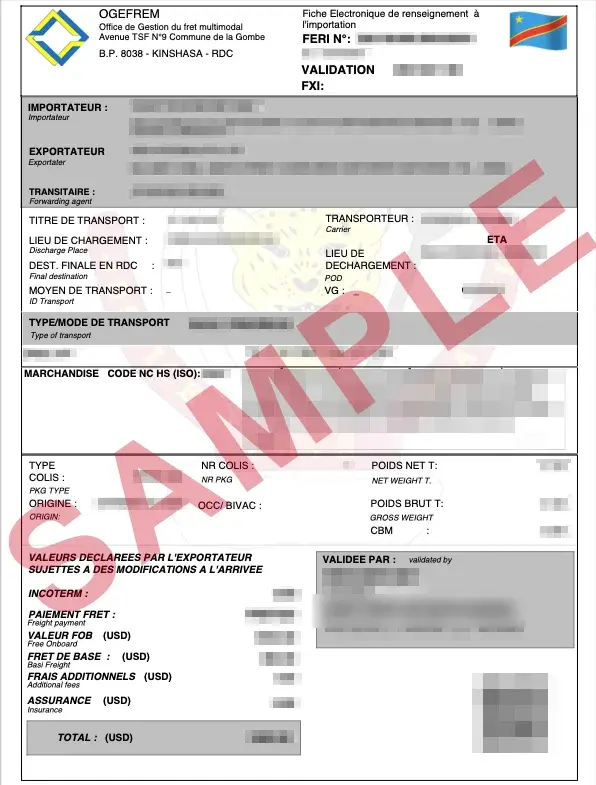
Official FERI Document Sample
Verify the layout, stamps, and ARCCLA customs format of a validated DR Congo loading certificate:
Application process
- 1The shipper or freight forwarder opens the FERI file before shipment and validates it in good time for the route — the exact cut-off depends on the destination.
- 2Prepare the Bill of Lading, Commercial Invoice, Freight Invoice, Packing List and the Customs Declaration (BOE / CE20).
- 3Our compliance desk validates the freight and cargo data against OGEFREM requirements and the importer's FXI number.
- 4OGEFREM issues the FERI number, which must accompany the shipment for clearance at Matadi or Boma.
- 5Validate in good time — surface freight and late filings attract severe OGEFREM penalties before the cargo can be cleared.
Timeline
| Step | Duration |
|---|---|
| Submit documents | Your action |
| Draft & invoice | 1 hour on average |
| Approve draft | Your action |
| Payment | Your action |
| Final validation | a few hours |
Special rules & HS codes
FXI licence and the full document set
The FERI links to the importer's FXI licence and typically requires the Bill of Lading, Commercial Invoice, Freight Invoice, Packing List and the Customs Declaration (BOE / CE20). OGEFREM applies severe penalties for surface-freight and late filings before the cargo can be cleared at Matadi or Boma.
Frequently asked questions
Ready to get your FERI?
Send your Bill of Lading and get your draft certificate today — fast, transparent, compliant.