When an ECTN application includes several commercial invoices in different currencies, checking each invoice individually is not enough. The values also need to make sense when the shipment is reviewed as a whole.
A recent Burundi-bound shipment provides a useful example.
The file contained three commercial invoices issued in two different currencies, while the export customs declaration recorded the total shipment value in a single currency. The documents were valid individually, but a small currency-conversion difference meant the combined invoice value did not fully reconcile with the declaration.
The discrepancy was identified during document review before the Burundi ECTN was submitted.
Shipment background
The shipment consisted of industrial machinery transported in five 40HC containers.
Route: Durban, South Africa → Dar es Salaam, Tanzania → Burundi
Because Burundi is landlocked, maritime cargo may enter through a regional port such as Dar es Salaam before continuing overland to its final destination.
For this shipment, the documentation provided for the ECTN application included:
- Bill of Lading
- Three commercial invoices
- Packing List
- Export customs declaration
- Relevant shipment and freight information
The unusual part of the file was not the number of invoices. It was the currencies in which they had been issued.
Three invoices, two currencies
Two of the commercial invoices were denominated in euros (EUR).
The third invoice was denominated in West African CFA francs (XOF).
The export customs declaration, however, showed the consolidated value of the shipment in EUR.
There is nothing inherently wrong with having commercial invoices in different currencies. International shipments frequently involve suppliers, contracts or transactions using different currencies.
The important point for an ECTN application is that the values reported across the supporting documents can be reconciled.
In this case, the XOF invoice therefore had to be converted into EUR before the combined value of all three invoices could be compared with the export declaration.
Where the discrepancy appeared
During the document check, the three invoice values were reviewed together.
The two EUR invoices could be added directly to the calculation. The XOF invoice first had to be converted to EUR using the applicable conversion ratio.
That calculation exposed a small difference.
The exchange rate used for the XOF invoice had been rounded. Once the converted amount was combined with the two EUR invoices, the resulting shipment value differed slightly from the EUR total recorded on the export customs declaration.
The difference was only a matter of cents.
From a commercial perspective, such a difference may appear insignificant. From a documentation perspective, however, it creates an inconsistency between two records that are supposed to describe the same shipment value.
Why currency rounding deserves attention
Currency conversion commonly introduces decimal differences.
Using a shortened conversion rate instead of the full applicable decimal rate can produce a small difference when a high-value invoice is converted. The effect becomes more noticeable when several invoices are subsequently combined.
For ECTN documentation, it is therefore better to work backwards from the complete shipment file rather than checking only whether the individual invoice calculations appear reasonable.
- What is the combined value of all commercial invoices?
- What currency is used on the export declaration?
- After converting the invoices into that currency, does the combined figure reconcile with the declared value?
That comparison can identify discrepancies that are not obvious when each document is viewed separately.
How the file was corrected
The inconsistency was identified before the ECTN application was finalized.
The client was informed that the conversion used for the XOF-denominated invoice needed to be reviewed. Their documentation was subsequently updated using a more precise conversion ratio.
The three commercial invoices were then recalculated and compared again with the export customs declaration.
Once the financial values reconciled, the remaining shipment data was checked as well, including:
- Cargo quantities
- Gross weights
- Container information
- Shipper and consignee details
- Information shown on the Bill of Lading
The corrected documents were then used to complete the Burundi ECTN application.
The practical lesson
The main issue in this case was not that the shipment contained invoices in different currencies.
It was that currency conversion created a discrepancy between the commercial invoices and the consolidated value declared elsewhere in the shipment documentation.
For exporters and freight forwarders dealing with a similar file, the safest approach is to create a simple reconciliation before submitting the documents.
| Document | Currency | Value used for reconciliation |
|---|---|---|
| Commercial Invoice 1 | EUR | EUR value |
| Commercial Invoice 2 | EUR | EUR value |
| Commercial Invoice 3 | XOF | Converted to EUR |
| Combined invoices | EUR | Total |
| Export customs declaration | EUR | Declared total |
The final two figures should be reviewed together before the ECTN application proceeds.
Multi-currency ECTN document checklist
When an ECTN application contains invoices in more than one currency, check:
- Which currency is used on each commercial invoice.
- Which currency is used on the export customs declaration.
- Which exchange rate has been applied to converted values.
- Whether excessive rounding has affected the calculation.
- Whether the converted invoice values reconcile with the declared shipment total.
- Whether quantities and weights also match across the invoice, Packing List and Bill of Lading.
Resolve discrepancies before filing.
A small discrepancy is much easier to resolve while the application is still being prepared than after the file has entered the validation process.
Preparing a Burundi ECTN application
For Burundi-bound cargo, document consistency should be checked across the complete shipment file rather than document by document.
Commercial invoice values, freight information, cargo weights, quantities and Bill of Lading details should describe the same shipment consistently.
If your shipment contains several invoices or invoices issued in different currencies, they can be reviewed together before the ECTN is filed.
Current Burundi ECTN information: getctn.com/en/burundi-besc-ectn
Official sources
Official Burundi ECTN (BESC) sources
The Burundi BESC is required by Burundi’s Ministry of Finance under Ministerial Ordinance 540/409 of 18 March 2014.
accessed
Top 3 causes of Burundi BESC rejection
- BESC number is not printed on the Bill of Lading.
- Invoice has not been stamped by the local Chamber of Commerce.
- Total weight differs by more than 5% between BL and packing list.
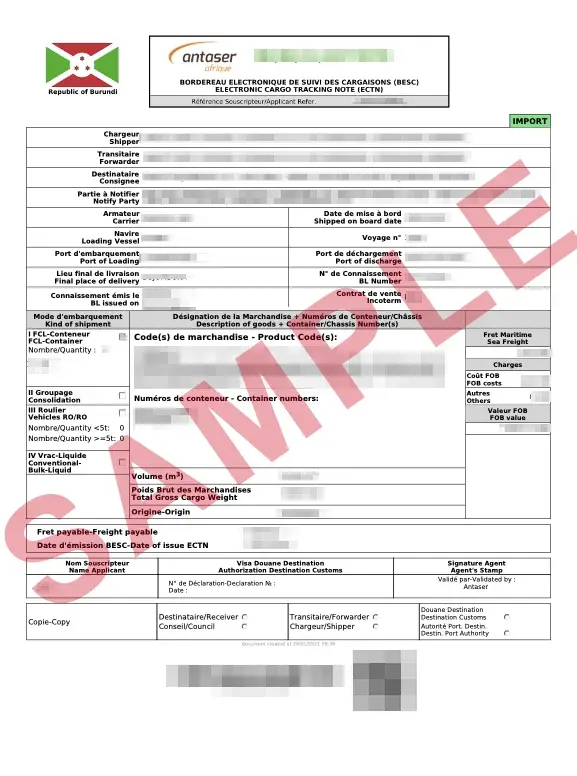
Official BESC Document Sample
Verify the layout, stamps, and BESC customs format of a validated Burundi loading certificate: