
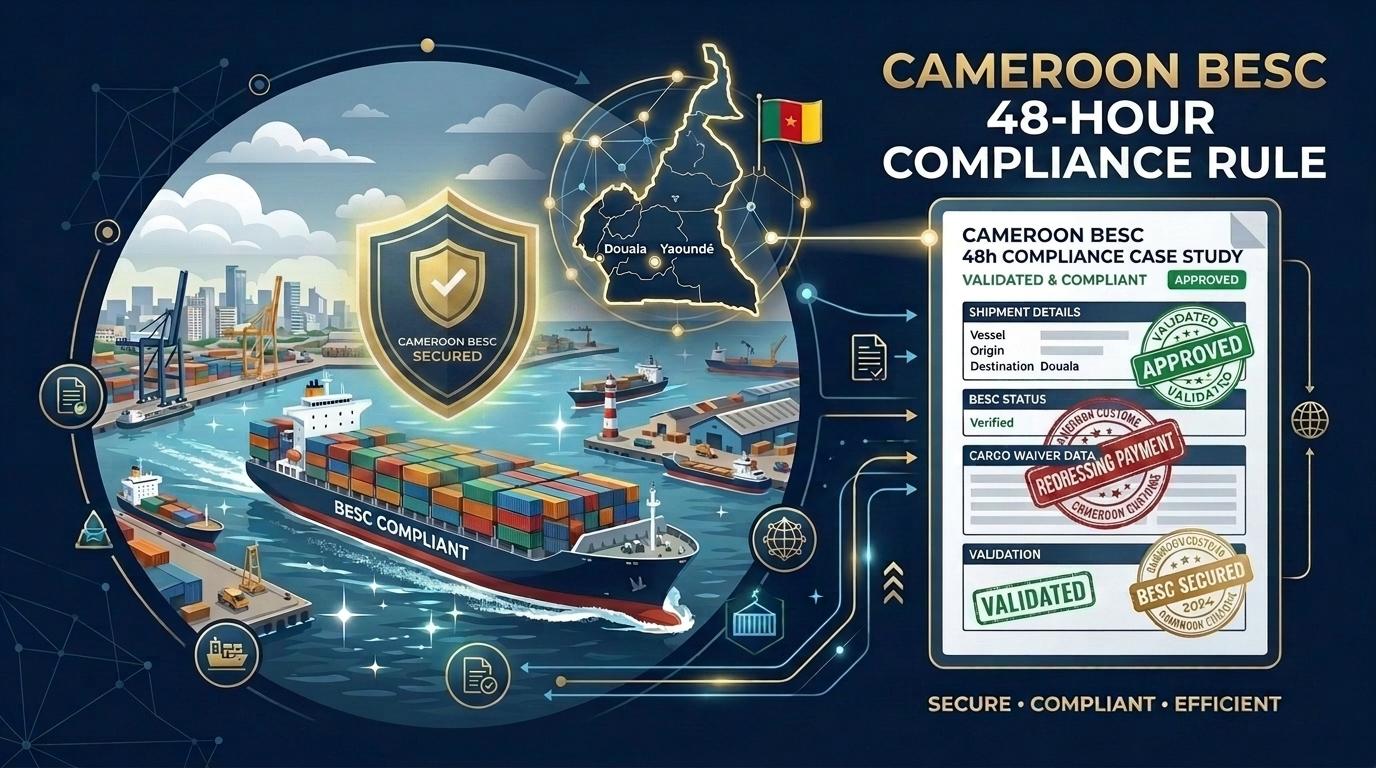
A case study from a real July 2026 file. Names and BL numbers changed; the timeline, the rule and the amounts are unchanged.
The short version
A French freight forwarder booked a container to Douala. Everything about the file was ordinary: documents complete, draft prepared inside 90 minutes, one clear approval question sent back the same morning. The forwarder took 24 hours to answer that question. That single day pushed the certificate submission inside Cameroon's 48-hour window, and the file came back from the CNCC platform stamped REDRESSING_PAYMENT — a penalty.
The penalty was €210. The certificate itself costs a fraction of the shipment's freight. Nothing was wrong with the paperwork. The cost came from a confirmation email that sat unread.
The rule everybody nods at and then misses
For Cameroon, the ECTN/BESC must be validated at least 48 hours before the vessel arrives at the port of discharge. Not submitted — validated. Miss it and the CNCC applies a penalty at the port of arrival; in the worst tier this reaches 200% of the certificate fee, payable in Douala before the cargo can clear.
Two details cause most of the trouble:
- Validation is not instant. Submission starts a queue on the council's platform. On a normal day it clears quickly; on a Thursday afternoon before a weekend, it may not.
- The clock runs on ETA, not on your booking date. A vessel that gains a day at sea shortens your window without telling you.
There is also a structural quirk on the current Cameroon platform: the ECTN number only exists after validation. You cannot print it on the Bill of Lading in advance — and you do not need to. That surprises first-time shippers and sometimes causes them to sit on a draft while they "wait for the number", which is exactly the delay that triggers the penalty.
The timeline
Day 1, 07:22 — The request arrives through the online form. Automated document reading splits a combined PDF into invoice, packing list and Bill of Lading, and creates the draft entry: Cameroon, one 40' container.
Day 1, 08:52 — Draft ready for review internally.
Day 1, 09:03 — Certificate submitted to the platform under an internal reference.
Day 1, 09:04 — Draft sent to the client with three requests: confirm the draft, advise ETA, and note that the ECTN number will appear only after validation. The email explains that replying with #approved or #correction triggers a priority route in the portal.
Day 2, 09:16 — The client replies: "Draft BESC is #approved. ETA on July 24." Twenty-four hours gone.
Day 2, 12:03 — The client chases: "This is a short transit time, we need the final BESC asap."
Day 2, 14:20 — Certificate submitted for validation.
Day 2, 14:59 — Platform response: not validated — REDRESSING_PAYMENT. The 48-hour window against the declared ETA had already closed.
Day 3, 06:47 — The client pushes back: "ETA is Sunday. We will not have to pay penalties."
Day 3, 09:56 — After a request for carrier tracking evidence, the correction arrives: "I made a mistake yesterday. The shipping line has confirmed ETA 25/07." One day later than what he had written — but the file had already been assessed against the earlier ETA he gave.
Day 3, 10:03 — Penalty confirmed: €210, with two ways to settle it. The importer pays at the CNCC office in Douala, or the agency invoices the forwarder and pays it on his behalf.
What actually went wrong
Not the documents. Not the filing. Three ordinary things:
A confirmation that waited a day. From receipt to draft-out took 1 hour 42 minutes. From draft-out to client approval took 24 hours. In a 48-hour rule, a 24-hour approval spends half your budget on one email.
An ETA given from memory. The forwarder wrote "July 24" and later found the carrier had confirmed "July 25". The council does not assess your file against your best recollection; it assesses against the arrival data. An ETA quoted casually in an email thread is the single most common source of penalty disputes we see.
Waiting for a number that does not exist yet. On the Cameroon platform there is nothing to wait for before approval. The draft is the last decision point that belongs to the shipper — after that the file leaves your hands.
The rules of thumb worth stealing
- Treat draft approval as a same-day task. If the file arrives in the morning, the draft comes back the same morning; answer it that afternoon, not tomorrow.
- Quote ETA from the carrier's tracking page, not from the booking email. Screenshot it. If tracking is down — which it was in this file — say so immediately rather than approximating.
- Start at booking, not at loading. For Cameroon, three working days of clearance ahead of ETA absorbs one client-side delay and one weekend. Two days absorbs neither.
- Reply with the approval prompt.
#approvedand#correctionin the reply body route the file straight to priority handling instead of the general queue. Free, and it saves hours on tight transits. - If a penalty does land, decide fast who pays it. Having the importer walk into the CNCC office in Douala is cheaper but slower; being invoiced for it is instant. Cargo does not clear while the two parties debate it.
What a penalty actually costs
€210 in this file. Set against that: the demurrage clock at Douala once cargo sits uncleared, the importer's storage, and the phone calls. Penalty fees are the visible number; port-side delay is usually the larger one, and it is the one nobody prices in advance.
None of it required special handling. It required an email answered on the day it arrived, and an ETA read off a tracking page.
Shipping to Cameroon and want the draft back the same day? Send the Bill of Lading, commercial invoice and packing list; we prepare the draft, submit it and track validation to certificate. Ask us for the ETA rule that applies to your specific port before you book.