
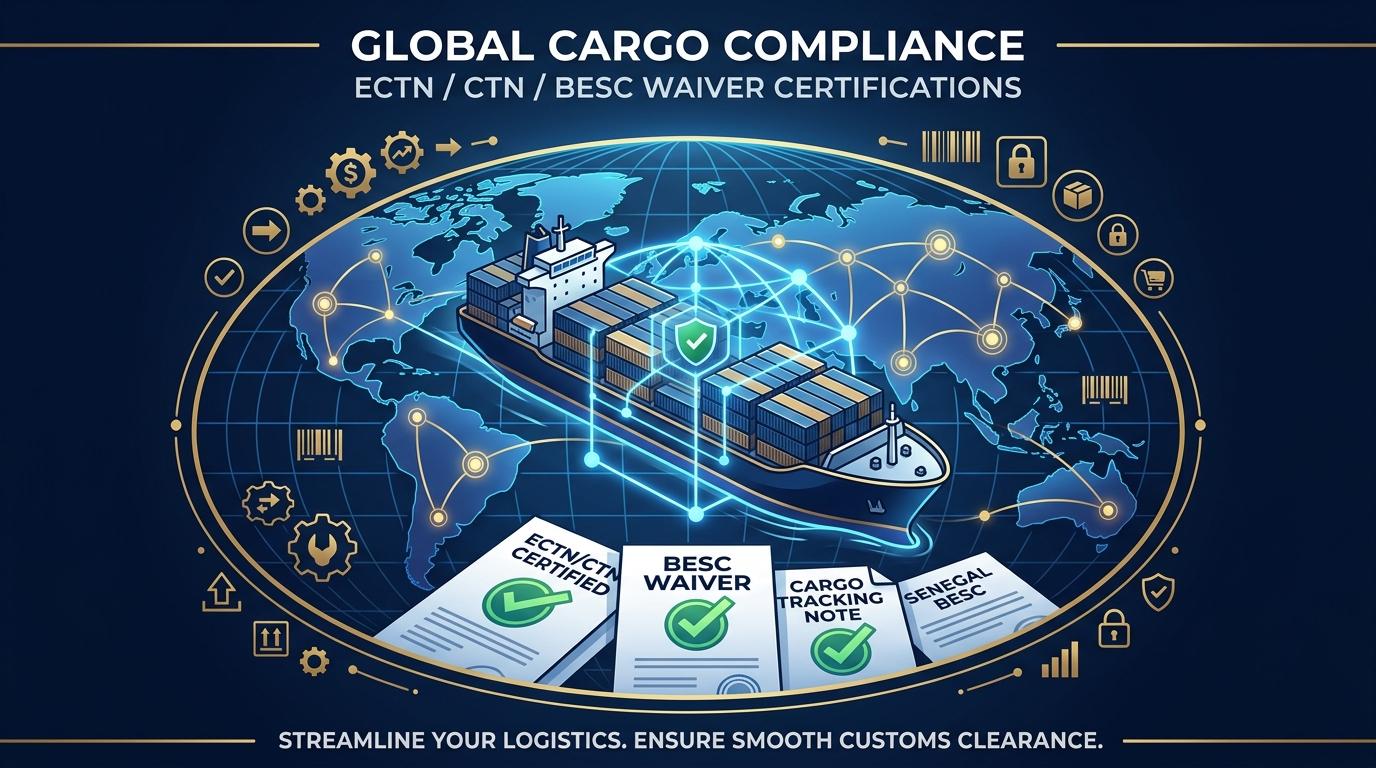
What is an ECTN?
The Electronic Cargo Tracking Note (ECTN) is a mandatory shipping document that declares a cargo to the destination's customs authority before it arrives. It is also called the Electronic Cargo Tracking Document (ECTD), or the Bordereau Electronique de Suivi de Cargaison (BESC) in French-speaking countries. The system lets governments monitor maritime imports, protect duty collection and check cargo declarations against what actually ships.
Which countries require an ECTN?
Thirty African destinations require a cargo tracking certificate, and the name changes from one to the next. This is the full list with the name each destination uses:
| Destination | Certificate | Country page |
|---|---|---|
| Angola | ARCCLA | Angola ARCCLA |
| Benin | BESC | Benin BESC |
| Burkina Faso | ECTN | Burkina Faso ECTN |
| Burundi | BESC | Burundi BESC |
| Cameroon | BESC | Cameroon BESC |
| Central African Republic | BESC | Central African Republic BESC |
| Chad | BESC | Chad BESC |
| Djibouti | ECTN | Djibouti ECTN |
| DR Congo | FERI | DR Congo FERI |
| Egypt | ACID | Egypt ACID |
| Equatorial Guinea | ECTN | Equatorial Guinea ECTN |
| Gabon | BIETC | Gabon BIETC |
| Gambia | ECTN | Gambia ECTN |
| Ghana | SPN | Ghana SPN |
| Guinea Bissau | CEE | Guinea Bissau CEE |
| Guinea Conakry | BESC | Guinea Conakry BESC |
| Ivory Coast | BSC | Ivory Coast BSC |
| Kenya | ACD | Kenya ACD |
| Liberia | BESC | Liberia BESC |
| Madagascar | BSC | Madagascar BSC |
| Mali | BESC | Mali BESC |
| Niger | BESC | Niger BESC |
| Republic of Congo | ECTN | Republic of Congo ECTN |
| Senegal | BSC | Senegal BSC |
| Sierra Leone | CTN | Sierra Leone CTN |
| Somalia | ECTN | Somalia ECTN |
| South Sudan | ECTN | South Sudan ECTN |
| Sudan | ACD | Sudan ACD |
| Togo | BESC | Togo BESC |
| Yemen | ACD | Yemen ACD |
If your destination is not listed, it may still run a scheme under another name — ask us before booking.
Why do countries require an ECTN?
The ECTN gives customs a declaration it can check before the vessel arrives rather than after. It serves four purposes:
- Cargo monitoring — tracking of shipments from origin to destination
- Revenue protection — helps prevent under-declaration of goods and supports proper duty collection
- Security — gives authorities detailed cargo information ahead of arrival
- Trade data — builds statistics for trade analysis and policy
How do you apply for an ECTN?
You send the shipping documents to an authorized agent, who validates them and issues the certificate. In practice:
- Contact GetCTN
- Submit the required documents, which change by destination — Bill of Lading and Commercial Invoice everywhere, plus a freight invoice, packing list, export declaration or country-specific form depending on where the cargo goes
- Pay the applicable fees
- Receive the validated ECTN certificate
When must the ECTN be filed?
It depends on the destination — some require the certificate before the vessel departs, others accept it up to arrival. Because the deadline is set per country and not by one common rule, check the country page for your destination before the vessel books.
What happens without a valid ECTN?
The cargo cannot be cleared, and the costs come from the delay as much as from the penalty:
- Significant fines
- Delayed cargo clearance
- Additional port storage charges
- Potential cargo detention
How do you stay compliant?
Confirm the requirement for the specific destination before every booking, because the rules change. Beyond that:
- Submit the application ahead of the shipping deadline
- Keep shipping documentation accurate and complete
- Work with an agent authorized for that destination
- Keep records of all certificates and related correspondence
Possible exemptions
Some destinations exempt certain cargo from the requirement. The categories usually named are:
- Diplomatic shipments
- Personal effects
- Humanitarian aid
- Military cargo
- Small postal packages
Which of these apply, and on what conditions, is set by each destination individually — confirm it for your route rather than assuming it.
Are ECTN systems moving to digital single windows?
Yes, in the destinations that have published a timetable — but this happens country by country and is not a regional trend. Two of the thirty destinations on this page have moved trade documentation onto a national single-window platform under a dated instrument:
| Destination | Single-window platform | In force since |
|---|---|---|
| DR Congo | S)ONE (GUICE) | 18 February 2026 |
| Egypt | NAFEZA (ACI system) | 1 October 2021 |
- DR Congo — a circular from the Ministry of Finance and the Ministry of Foreign Trade requires all import, export and transit documentation to pass electronically between GUICE's S)ONE platform and SYDONIA WORLD, the customs system used by the DGDA. Transmission opened on 29 December 2025 and became mandatory across the country on 18 February 2026; an operation conducted outside the official GUICE channel is deemed irregular. What changed in the DRC
- Egypt — the ACID number has been registered through the NAFEZA single-window platform (the ACI system) since 1 October 2021, under Customs Law No. 207/2020. The Egyptian importer registers it before the cargo ships, for sea shipments to Alexandria, Port Said and Damietta. Egypt ACID requirements
The practical consequence is that the filing channel can change while the certificate itself does not. Check the current channel for your destination rather than reusing last year's procedure.
Conclusion
The ECTN is the declaration that lets African customs authorities assess a shipment before it lands. Knowing which certificate your destination uses, what it needs and when it is due is most of the work.