
Overview
The BESC — Bordereau Électronique de Suivi des Cargaisons — is the electronic cargo tracking note required for sea shipments to Central African Republic, which discharge at Bangui (Dry Port via Douala). It ties the shipper, consignee, cargo and freight values on your Bill of Lading to a single reference that customs can reconcile before the cargo is worked. Filing deadline: Issued at the port of loading, before the cargo is loaded. Cargo that only passes through on its way to a landlocked neighbour is treated as in-transit and still needs a certificate, so the routing has to be documented from the start.
Discharge ports
Required documents
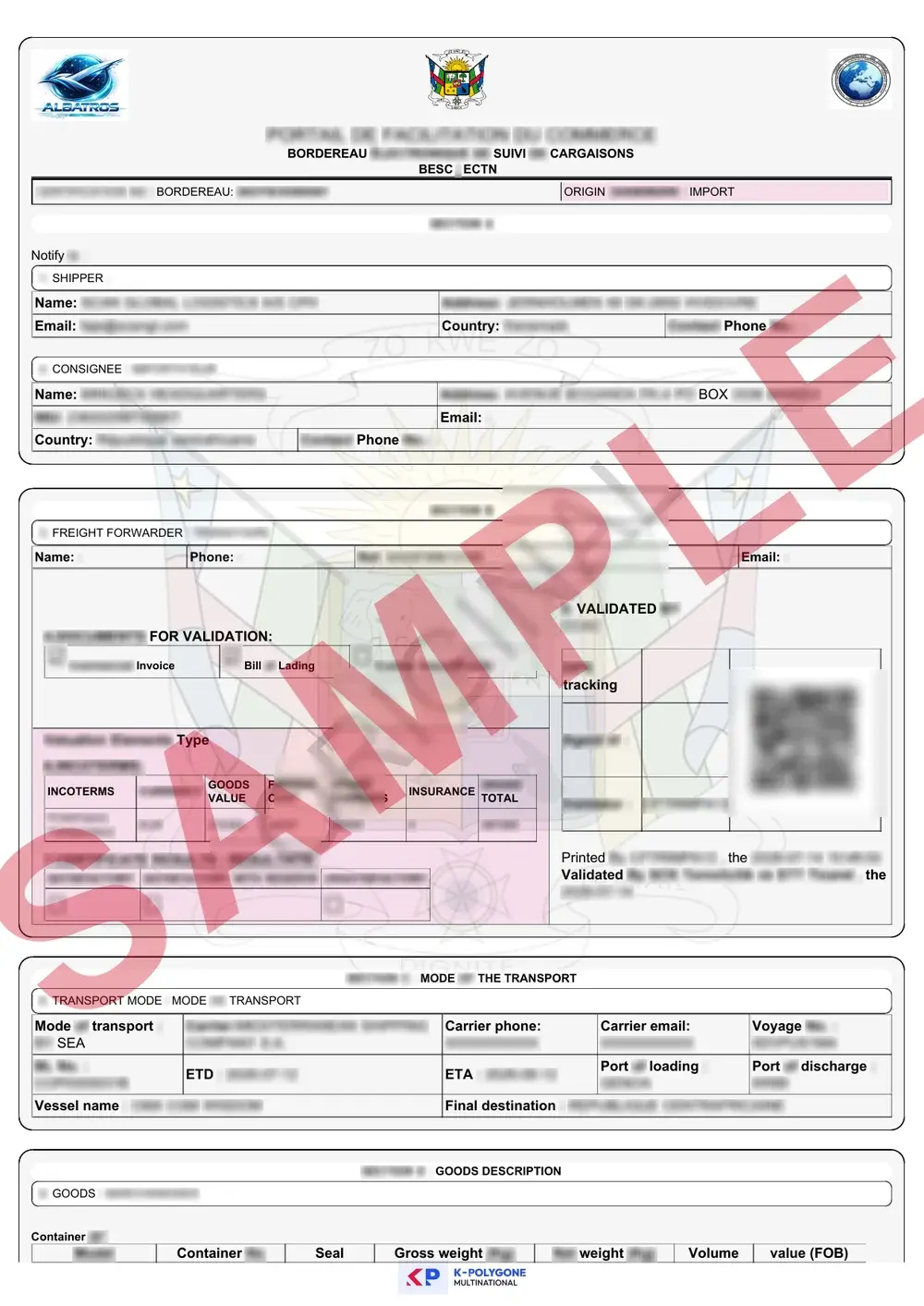
Official BESC Document Sample
Verify the layout, stamps, and BESC customs format of a validated Central African Republic loading certificate:
Application process
- 1SubmitSend your Bill of Lading and Commercial Invoice, with the Freight Invoice if freight is not shown on the commercial invoice.
- 2Draft & invoiceWe prepare a draft certificate and a fixed-price invoice within 1 hour on average.
- 3ApproveYou review the draft and confirm every detail before anything is filed.
- 4PaymentThe fixed-price invoice is settled so the file can go forward for validation.
- 5ValidateThe certificate is validated and the final BESC number is confirmed.
Timeline
| Step | Duration |
|---|---|
| Submit documents | Your action |
| Draft & invoice | 1 hour on average |
| Approve draft | Your action |
| Payment | Your action |
Special rules & HS codes
Rule 1
The BESC number is issued at validation, so it cannot be supplied in advance.
Rule 2
Final, dated MBL is required prior to validation.
Rule 3
Shipper, consignee and notify parties address must match between all documents.
Rule 4
Weight on export declaration must match the BL.
Rule 5
Statistical value on export declaration must match the commercial invoice.
Rule 6
Shipper owned containers must have the tare weight mentioned on the BL.
Rule 7
Printing the BESC number on the Master Bill of Lading is not required by the authority, but individual carriers may ask for it.
Official sources
Central African Republic BESC: official notices
The BESC for the Central African Republic is run by ANTASER, which publishes the customs circulars and notices for the country.
accessed
Top 3 causes of Central African Republic BESC problems
- The NIU of the importer or exporter is missing, so the BESC cannot be validated.
- The BESC was not obtained at the port of loading: a regularisation BESC at a transit port is not accepted.
- Parties, addresses, weights or values differ between the Bill of Lading, the invoice and the export declaration.
Specific questions: Central African Republic
What is the NIU on the Central African Republic BESC?
The NIU (Numéro d’Identification Unique) is the unique identification number of the trader. It is now a mandatory field on the BESC application and on the validated BESC: the importer’s NIU for an import shipment, the exporter’s NIU for an export. A BESC that was validated before the change but has not yet been checked at destination has to be updated with the NIU.
Can the Central African Republic BESC be obtained at Douala or another transit port?
No. A customs circular of 16 December 2016 prohibits issuing a regularisation BESC at a transit port; only a BESC issued at the port of loading is accepted. Cargo without one stays at the port of discharge until it is regularised online, with fines.
Who runs the Central African Republic BESC?
ANTASER runs the online BESC for the Central African Republic, where it has been operational since 27 February 2012. A court judgment of 15 July 2026 restored ANTASER’s right to carry on the activity.
Is the Central African Republic ECTN the same as the BESC?
Yes. Searches for the Central African Republic ECTN mean the BESC, the name printed on the certificate.
Do I need a Central African Republic ECTN for cargo discharged at Douala or Pointe-Noire?
Yes. The Central African Republic ECTN follows the final destination, not the port: cargo for Bangui discharged at Douala, Kribi or Pointe-Noire needs the Central African Republic ECTN, issued as the BESC at the port of loading. Whether the transit country also asks for its own certificate depends on the port; tell us the port of discharge with the Bill of Lading.
Frequently asked questions
Ready to get your BESC?
Send your Bill of Lading and get your draft certificate today — fast, transparent, compliant.