
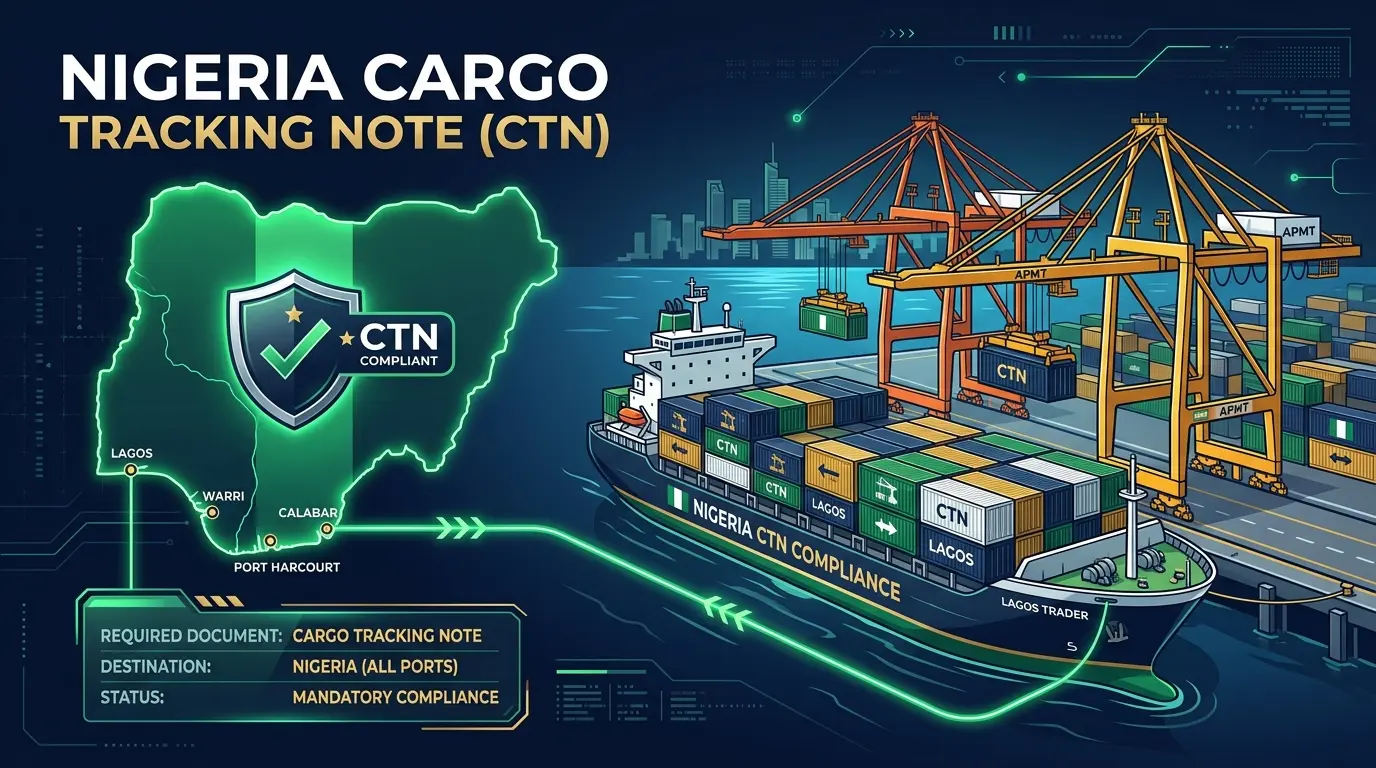
Status update (October 2026)
Nigeria's cargo tracking note, now called the International Cargo Tracking Note (ICTN), is not in force. The Nigerian Shippers' Council has the President's approval to proceed with procurement and hopes implementation will start before the end of 2026, but no start date has been set. Two earlier attempts were suspended amid legal challenges from importers and licensed customs agents; the Nigeria Customs Service points to Section 28 of the Nigeria Customs Service Act 2023 as the basis for electronic cargo tracking.
Until the ICTN starts, no cargo tracking note is required for Nigeria. Regulated products still need SONCAP, which is a product-conformity certificate, not a cargo tracking note. We will update this page when a start date is announced.
Sources: The Guardian Nigeria: ICTN gets presidential nod as 2026 procurement begins · BusinessDay: Customs defends International Cargo Tracking Note · Leadership: Shippers Council gets President's nod
Nigeria CTN Requirements
The CTN Document is being set up in Nigeria
The long wait is over. According to recent announcements from Nigeria's government agency, the Federal Government has advocated establishing the loading certification system called Cargo Tracking Note (CTN). This system, already operational in more than 27 African countries, was requested by the Nigerian Shippers Council and was expected to be implemented by the end of 2019.
What is the Purpose of a CTN Certificate?
Firstly, Security
The general purpose of Nigeria's CTN is to contribute to risk reduction regarding unlawful goods, ensure reliable auditing of imports, and protect all parties in the transport chain. Denying commodity importation while goods remain in the country of origin provides greater assurance for national well-being and supports the government's fight against counterfeit products.
Secondly, Port Management
Representatives from ports with established CTN certificates acknowledge that the Advance Declaration system benefits port traffic management. Nigeria's 853 km coastline contains many inadequately maintained ports that would benefit significantly from this requirement. The system provides real-time monitoring of vessel flow and enables port managers to allocate docking space and unloading equipment efficiently.
Thirdly, Under-Declaration of Goods
CTN supporters emphasize combating the concealment of true goods value. Reports indicate that up to 80% of imported goods are under-declared. (Source: the head of the Nigeria Customs Service, quoted by Prime Time Reporters, 25 September 2017: 70% to 80% of imports arrive under false declaration.) Nigerian Customs Authorities assert that CTN documentation will eliminate this practice. Shippers and exporters must declare cargo value on Commercial Invoices and Statistical value on Export Entry Bills. With Pre-Arrival Assessment Regime (PAAR), customs authorities can evaluate declared goods values and impose appropriate tariffs.
How to Apply for Nigeria CTN?
The procedure is straightforward. Provide a required document list via email. GetCTN will review them and identify any discrepancies. Once acceptably revised, they will generate your CTN certificate. The Nigerian Customs Authorities will approve the application, permitting you to proceed with your export shipment.