
Overview
The Angola ARCCLA certificate — still widely called the CNCA — is required for ocean shipments bound for an Angolan port. The shipper or freight forwarder obtains and validates it: it is the exporter side, not the Angolan importer, that is responsible for filing. Filing deadlines differ by destination — some routes require validation before the vessel departs, others later — so we confirm the cut-off for your route before anything is filed, and filing early protects the cargo from fines and demurrage either way. Four things decide whether the file clears on the first attempt: the importer must hold a valid ARCCLA authorization, which we check at the start; declared goods values must sit within 5% of the commercial invoice, because larger gaps trigger a query; vehicle and road components need an additional prior-authorization document, listed by HS code further down; and consignee details must match the importer’s NIF exactly. Cargo that only passes through an Angolan port on its way to a landlocked neighbour is treated as in-transit and does not need a certificate — but the routing has to be documented.
Discharge ports
Required documents
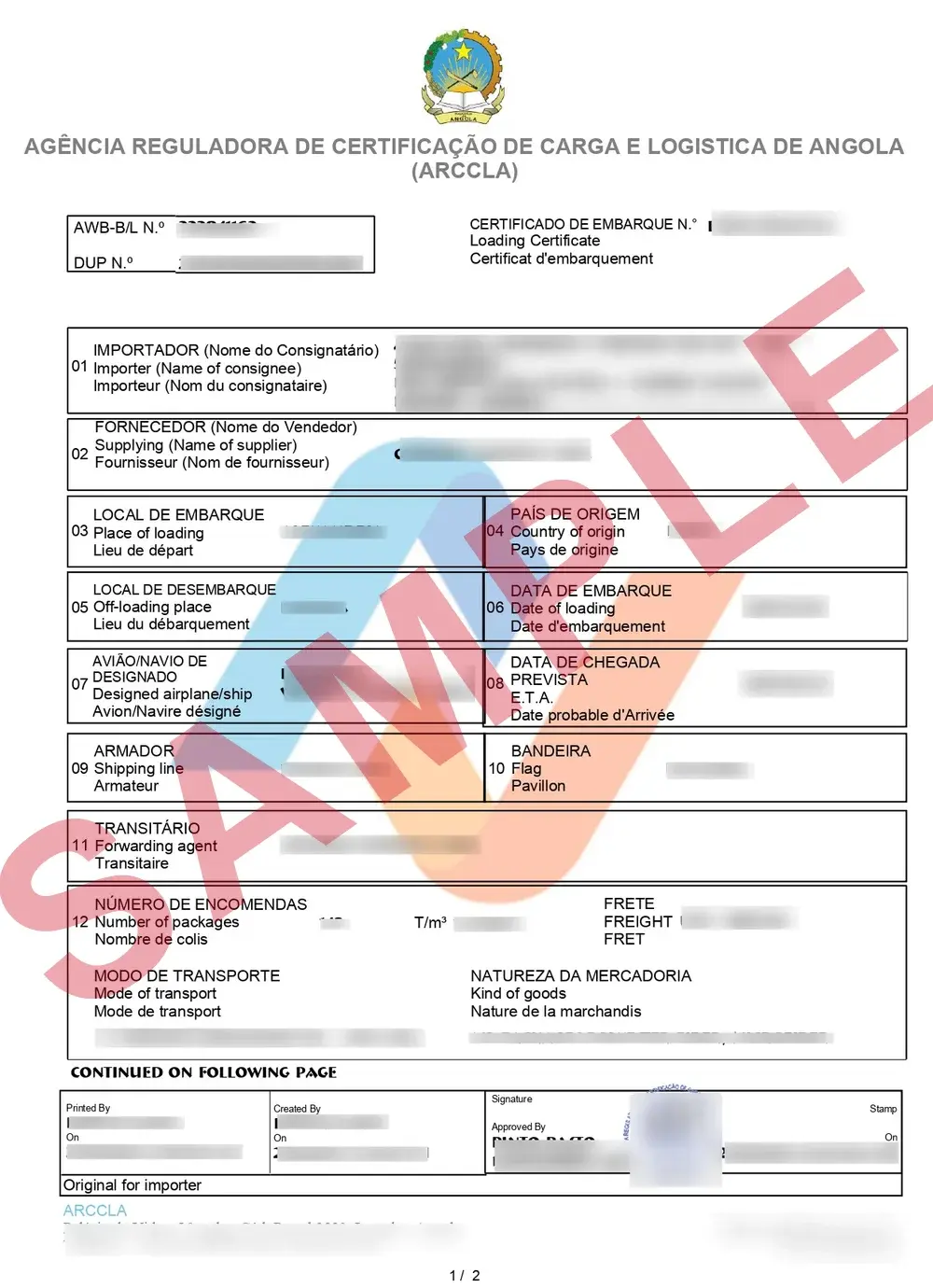
Official CNCA Document Sample
Verify the layout, stamps, and ARCCLA customs format of a validated Angola loading certificate:
Application process
- 1SubmitSend your Bill of Lading and Commercial Invoice by email or through the portal.
- 2Draft & invoiceWe prepare a draft certificate and a fixed-price invoice within 3–6 hours.
- 3ApproveYou review the draft and confirm every detail is correct before anything is filed.
- 4PaySettle the transparent invoice — government fee plus our fixed service fee, no surprises.
- 5ValidatedThe final validated CNCA certificate is issued to your inbox, ready for customs.
Validation is the point at which ARCCLA registers the certificate against your shipment. It only begins after you have (1) approved the draft details and (2) settled the invoice — so accurate documents and prompt approval are what make the 3–6 hour turnaround possible.
Timeline
| Step | Duration |
|---|---|
| Submit documents | Your action |
| Draft & invoice | 3–6 hours |
| Approve draft | Your action |
| Payment | Your action |
| Final validation | 3–6 hours |
Special rules & HS codes
Road & vehicle components — prior authorization
Since 1 June 2025, imports of vehicles and road components require an additional authorization from the relevant Angolan transport authority. If your cargo falls under any of the HS codes below, that authorization must accompany the CNCA file.
| HS Code | Component |
|---|---|
| 8408.20 | Engines used for vehicle propulsion |
| 8708.40 | Gearboxes, including gears and parts |
| 8706.00 | Chassis fitted with engines |
| 8707.00 | Bodies, including cabins |
| 8708.94 | Steering systems (columns, wheels, cables) |
| 8708.80 | Suspension systems, including shock absorbers |
| 8708.50 | Transmission systems |
Suspended import HS codes
Angola has suspended imports of the following goods for an indefinite period. Cargo under these HS codes cannot currently clear — confirm with our desk before booking.
| HS Code | Item |
|---|---|
| 1101.00 | Wheat flour |
| 1102.00 | Maize flour |
| 1507.10 / 1511.10 | Refined sunflower, palm and soya oils |
| 3926.10 | School and professional gowns |
| 6103.49 | Uniforms, including military and police |
| 1704.90 | Confectionery products |
| 6302.32 | Hospital consumables |
| 2514.00 | Plasterboard |
Frequently asked questions
Ready to get your CNCA?
Send your Bill of Lading and get your draft certificate today — fast, transparent, compliant.