

What is the FDI document?
The FDI — Fiche de Déclaration à l'Importation (Import Declaration Form) — is a pre-shipment declaration used in the import process for Côte d'Ivoire (Ivory Coast). It records the key facts of a shipment — who is importing, who is exporting, what the goods are, their tariff classification and declared value, and the transport details — so the destination authorities can identify and reconcile the consignment before it arrives at Abidjan or San Pédro.
In practice the FDI travels alongside the BSC (Bordereau de Suivi des Cargaisons, the Electronic Cargo Tracking Note): the BSC is the cargo-tracking waiver, and the FDI is the underlying import declaration whose reference the BSC and the customs file are built around. Getting the FDI right is therefore a prerequisite for a clean BSC validation.
This document is required for Ivory Coast BSC clearance. Click through for the full BSC rules, documents and deadlines.
Why does the FDI matter?
Côte d'Ivoire, like most West-African maritime destinations, processes imports through an electronic single-window workflow (the Guichet Unique du Commerce Extérieur, GUCE). The declaration and the cargo-tracking note let customs:
- Identify the parties — importer/consignee and exporter/shipper.
- Classify the goods — description and HS tariff code.
- Verify the value — the declared CIF value against the commercial invoice.
- Reconcile the transport — Bill of Lading, vessel and ports against the manifest.
A missing, late or inconsistent FDI is one of the most common reasons a BSC is delayed or rejected, which in turn exposes the cargo to storage and demurrage charges at the port.
What does the FDI contain?
A well-prepared FDI mirrors the commercial and transport documents. The core fields are:
- Importer / Consignee — the final buyer in Côte d'Ivoire.
- Exporter / Shipper — the seller abroad.
- Description of goods and HS tariff code.
- Country of origin.
- Invoice value (CIF) — consistent with the Commercial Invoice.
- Bill of Lading number, vessel / voyage, port of loading and port of discharge (Abidjan or San Pédro).
- The linked BSC / cargo-tracking reference.
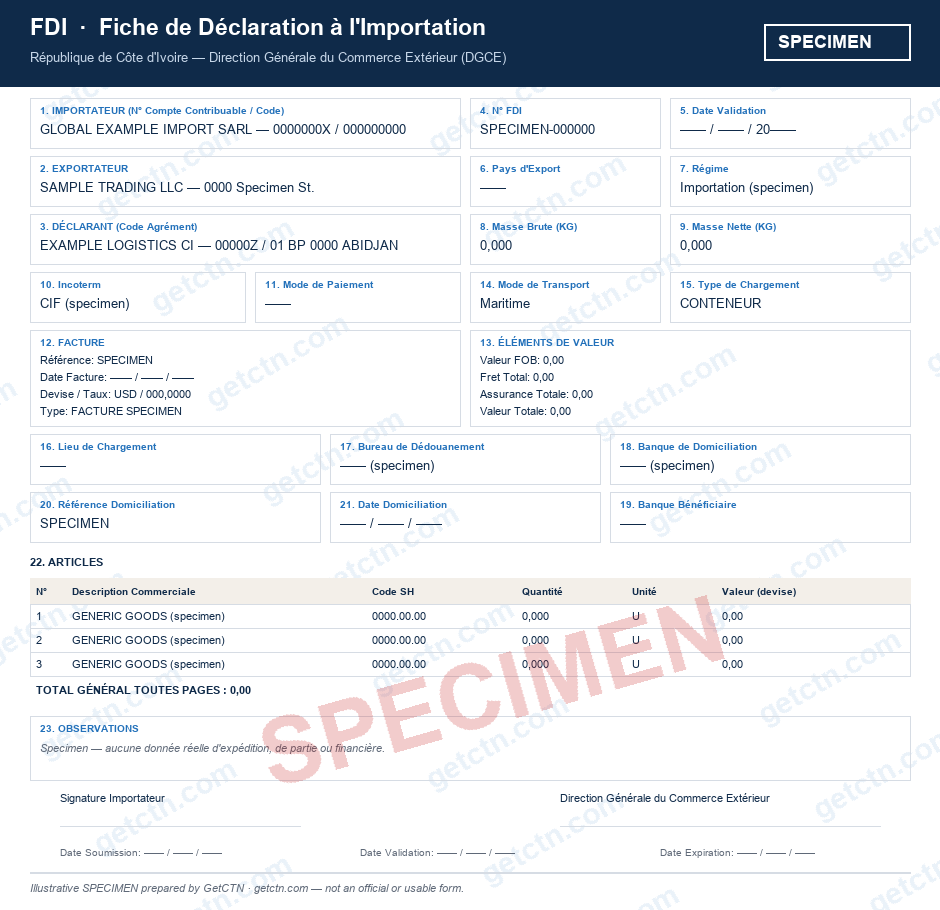
Sample FDI (specimen)
Below is a specimen for illustration only. It carries no real party, shipment or financial data, and is watermarked — it is not a usable or official form:
How does the FDI link to the BSC?
The FDI and the BSC are two halves of the same file:
- You prepare the FDI from your Bill of Lading and Commercial Invoice.
- The declaration data feeds the BSC application.
- A senior officer cross-checks every field — weights, values and party details — against your Bill of Lading before the BSC is validated.
- The validated BSC is issued with a unique reference that ties back to the declaration.
Because the two are linked, an error on the FDI usually surfaces as a BSC rejection. Our desk reconciles both before filing so they match.
Why is an FDI rejected?
An FDI is rejected when the declaration does not match the shipping documents. The usual causes are:
- Incomplete importer or exporter details on the declaration.
- Declared values inconsistent with the Commercial Invoice.
- HS code mismatch with the actual goods.
- A missing FDI reference or a number that does not match the Bill of Lading.
- Late filing — submitted after the vessel-departure deadline.
Get help with your FDI and BSC
Send us your Bill of Lading and Commercial Invoice and our compliance desk prepares the FDI and the matching Ivory Coast BSC, cross-checks every field, and returns a validated certificate — usually within a few hours once the documents are correct.