
Overview
The ECTN — Electronic Cargo Tracking Note — is the electronic cargo tracking note required for sea shipments to Central African Republic, which discharge at Bangui (Dry Port via Douala). It ties the shipper, consignee, cargo and freight values on your Bill of Lading to a single reference that customs can reconcile before the cargo is worked. Filing deadlines differ by destination — some require the certificate before the vessel sails, others later — so we confirm the exact cut-off for your route before anything is filed. Cargo that only passes through on its way to a landlocked neighbour is treated as in-transit and still needs a certificate, so the routing has to be documented from the start.
Discharge ports
Required documents
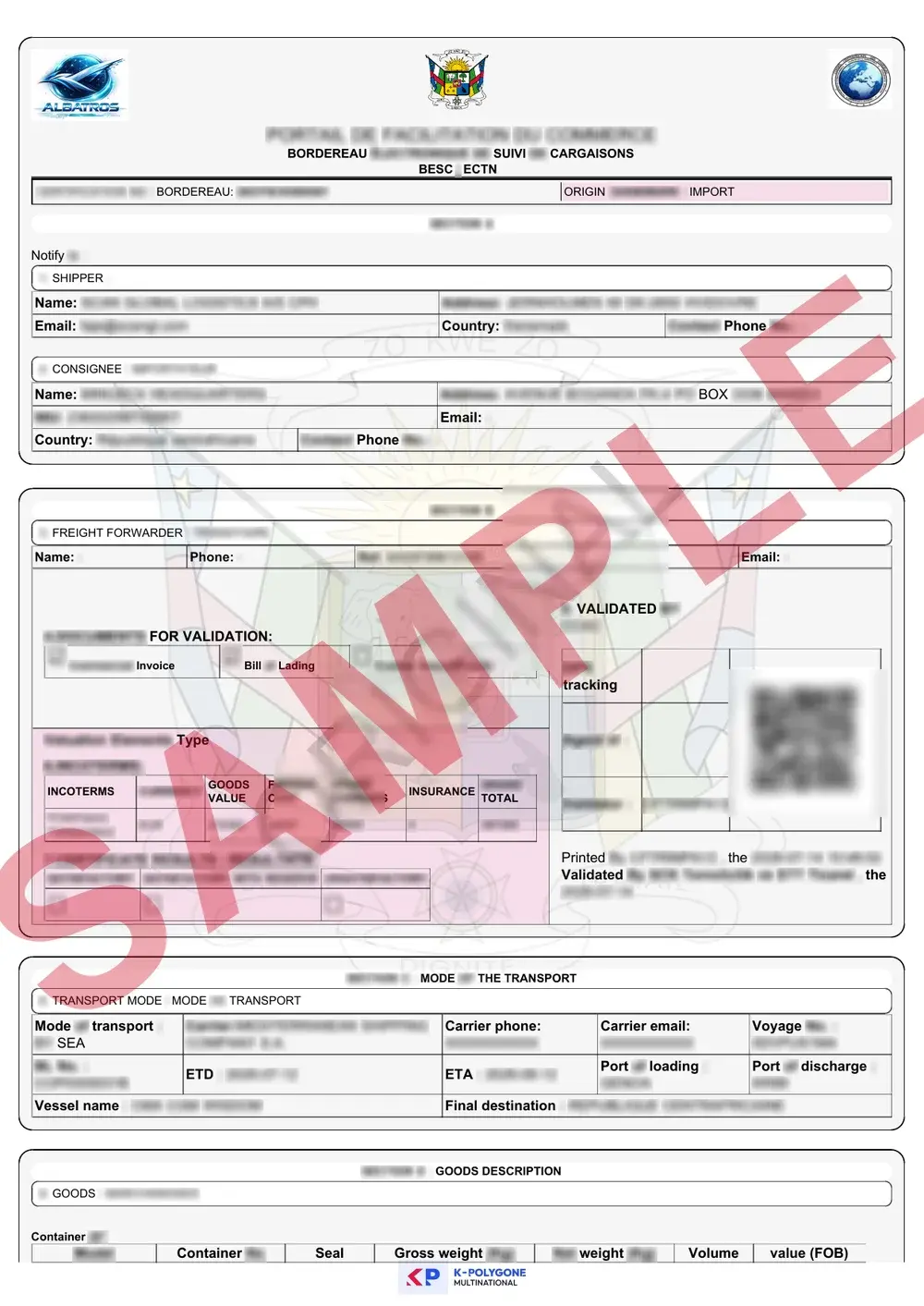
Official ECTN Document Sample
Verify the layout, stamps, and ARCCLA customs format of a validated Central African Republic loading certificate:
Application process
- 1SubmitSend your Bill of Lading and Commercial Invoice, with the Freight Invoice if freight is not shown on the commercial invoice.
- 2Draft & invoiceWe prepare a draft certificate and a fixed-price invoice within 3–6 hours.
- 3ApproveYou review the draft and confirm every detail before anything is filed.
- 4PaymentThe fixed-price invoice is settled so the file can go forward for validation.
- 5ValidateThe certificate is validated and the final ECTN number is confirmed.
Timeline
| Step | Duration |
|---|---|
| Submit documents | Your action |
| Draft & invoice | 3–6 hours |
| Approve draft | Your action |
| Payment | Your action |
Special rules & HS codes
Rule 1
The ECTN number is issued at validation, so it cannot be supplied in advance.
Rule 2
Final, dated MBL is required prior to validation.
Rule 3
Shipper, consignee and notify parties address must match between all documents.
Rule 4
Weight on export declaration must match the BL.
Rule 5
Statistical value on export declaration must match the commercial invoice.
Rule 6
Shipper owned containers must have the tare weight mentioned on the BL.
Rule 7
Printing the ECTN number on the Master Bill of Lading is not required by the authority, but individual carriers may ask for it.
Frequently asked questions
Ready to get your ECTN?
Send your Bill of Lading and get your draft certificate today — fast, transparent, compliant.