
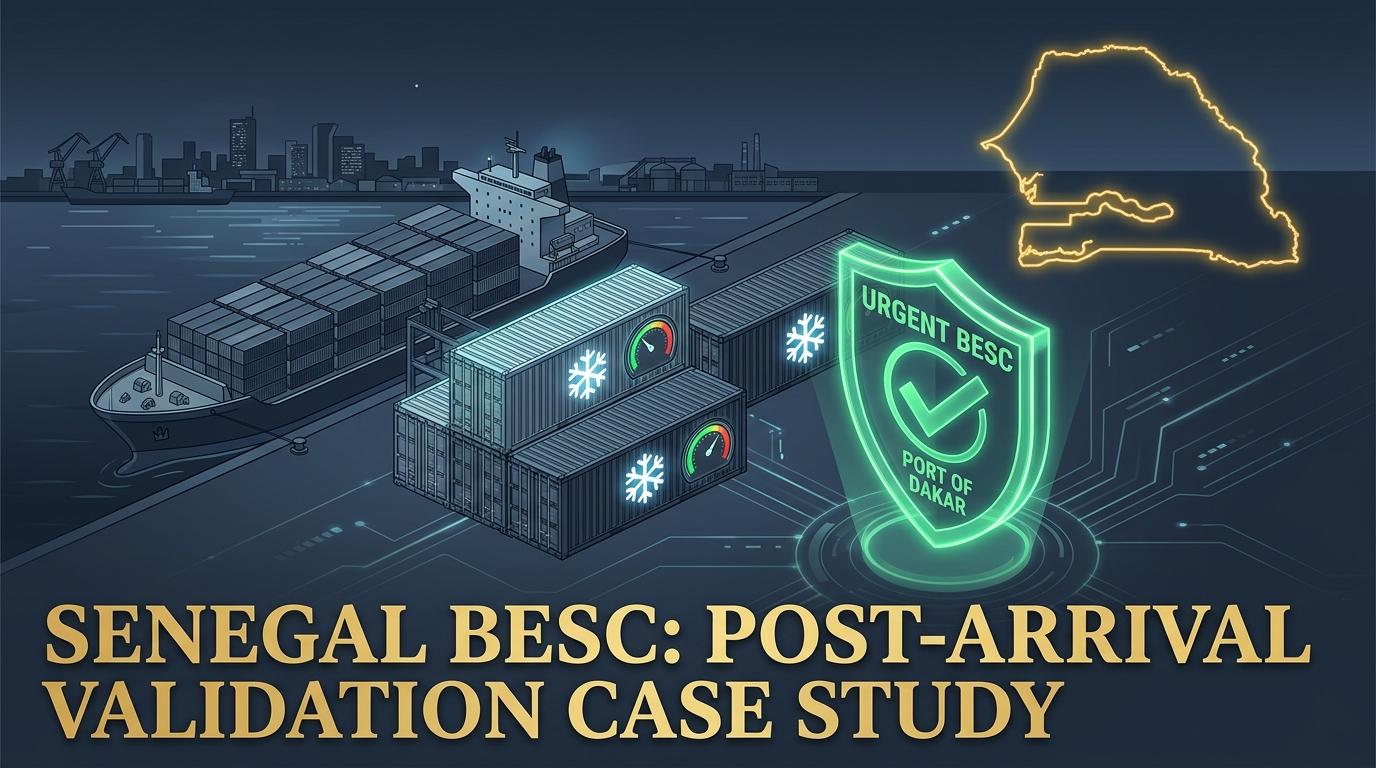
Asking for the Senegal BSC after the vessel has arrived at Dakar is the most expensive way to get one. The BSC (Bordereau de Suivi des Cargaisons), mandatory for Senegal and administered by COSEC (Conseil Sénégalais des Chargeurs), is no harder to issue once the ship is alongside. Everything around it becomes expensive: the customs hold, the days of terminal storage and — on a reefer — the cargo.
The case: two 40' RF containers of food products, loaded at Cape Town, destination port of Dakar. No BSC requested before departure, none while the vessel was en route. By the time the file reached our desk the ship was alongside and customs had held the clearance.
The sequence is the same from any load port: what changes is the transit time, not the obligation or the regularisation procedure.
A case study from a real file. Names and Bill of Lading numbers changed; the sequence and the documents are unchanged.
Before loading vs. after arrival
| Item | Applied before loading | Applied with the vessel alongside |
|---|---|---|
| COSEC penalty | None | Applies, charged at regularisation |
| Customs clearance | Normal | Held until a validated certificate exists |
| Terminal storage | None | Runs from discharge |
| Reefer plug-in | None | Runs from day one |
| Margin for error | A second round of queries is manageable | None: every query is another day of storage |
| Documents required | Bill of Lading, commercial invoice, freight invoice | The same, but with no margin |
A customs hold is not a slowdown: it stops the release. And it does not lift by explaining that the certificate is "on the way". It lifts when a validated certificate exists.
The procedure, step by step
- Document collection — the client sends the Bill of Lading, the commercial invoice and the freight invoice.
- Cross-check — the compliance officer compares the three documents against each other before anything is filed.
- Draft — the compliance officer generates the BSC draft.
- Client confirmation — the client approves the draft. On an arrived vessel this step has to close the same day.
- Filing with COSEC — the complete application is submitted with urgent priority, noting the vessel already alongside.
- Validation and issue — the authority's step alone. In this case: the same day it was filed.
- Release and clearance — the client presents the validated certificate, lifts the hold and collects the containers.
The check at step 2 looks like the one to skip on an urgent file. It is the opposite. A single mismatch comes back as a query, and a query on an arrived vessel costs another day of storage and plug-in.
Elements checked across all three documents:
- container numbers
- seal numbers
- cargo description
- weight breakdown
- freight charges
On this file everything reconciled, so the authority had no reason to raise a query.
Mandatory documents
- Bill of Lading (B/L) — draft or final
- Commercial invoice
- Freight invoice
A validated BSC carries a reference number that can be verified with COSEC: always ask for the reference, not just the PDF.
What changes when the vessel has already arrived
- The certificate stays the same; the penalty, the hold and the storage days are what change.
- The application has to be marked urgent, noting the vessel alongside.
- There is no room for a second round: the file must be clean at first filing.
- On a reefer the clock runs on the cargo too, not only on the storage.
- Speed comes from documents that agree with each other, not from chasing the authority.
What to take from this
It is not the certificate that weighs. It is the timing. Filing before departure removes the penalty, the hold and the storage in one move. On reefers the BSC belongs to the booking, not to the arrival paperwork: the plug-in charge runs from day one.
The destination requirements are on the Senegal BSC page. For a first application, the full sequence is in 5 easy steps to get a Senegal BSC certificate.
Vessel already alongside at Dakar? Send the Bill of Lading and commercial invoice through the quote form and ask for the urgent route: a compliance officer checks the documents before anything is filed with COSEC.