A case study from a real file. Names and Bill of Lading numbers changed; the sequence, the documents and the correction are unchanged.
A container number and a seal number are only useful together. Paired wrongly across two documents, they stop describing the shipment and start contradicting it — and a customs officer reading both files sees an inconsistency, not a typo.
This is what a pre-filing audit caught on a twenty-two container shipment of food products from the Port of Casablanca, Morocco, to the Port of Tamatave, Madagascar.
The shipment
Twenty-two 20-foot containers, food products, Casablanca to Tamatave. Every sea shipment to Madagascar needs a validated BSC (Bordereau de Suivi des Cargaisons) before customs clearance, so accurate cross-referencing between documents is not paperwork — it is the clearance itself.
The exporter submitted the full set Malagasy regulations require:
| Document | Purpose in the file |
|---|---|
| Bill of Lading | The carrier's record: containers, seals, parties, ports |
| Commercial Invoice | Declared value of the goods |
| Freight Invoice | Declared cost of carriage |
| Export Customs Declaration | The origin side of the movement |
| Packing List | What is inside each container, and which seal closes it |
What the audit found
While preparing the certificate draft, our compliance operator cross-read every file against every other.
Both the Bill of Lading and the Packing List accounted for all 22 containers and all 22 seals. Neither was missing anything. But on the Packing List the seal numbers were paired with the wrong container numbers — each seal existed, each container existed, and the assignments between them contradicted the Bill of Lading.
On a single-container shipment that error is visible at a glance. Across twenty-two rows it is not, which is exactly why it survives to the filing stage.
Why it matters at Tamatave
Customs officers inspect container and seal pairings individually, and they compare documents against each other rather than reading them in isolation. A file that disagrees with itself does not raise a question — it fails validation. What follows is a rejection, a resubmission, and the days of demurrage and storage that accumulate while the containers sit.
The correction
We flagged it before anything was filed, contacted the client the same day and explained the requirement plainly: the seal numbers on the Packing List must match the pairings on the final Bill of Lading, row for row.
The client's logistics team recognised the oversight and issued a revised Packing List with the pairings synchronised. Our operator finalised the BSC draft against the corrected set, sent it for the client's verification, and submitted the file to the authorities on approval.
The Madagascar BSC was validated with no administrative queries. All 22 containers cleared customs at Tamatave without demurrage or port penalties.
What to check before you file
- Read the two documents against each other, not one after the other. Each was internally complete here; only the comparison revealed the fault.
- Treat the Bill of Lading as the authority on pairings. It is the carrier's record and the document customs will trust.
- Check every row. A shipment can carry the right containers and the right seals and still be wrong about which closes which.
- Do it before filing. A correction costs one email before submission and a rejection cycle after it.
Shipping to Madagascar? See the Madagascar BSC requirements or the full Madagascar BSC guide.
Official sources
Official Madagascar BSC sources
The BSC is required by Madagascar Customs (Direction Générale des Douanes) and run on GasyNet’s system.
- Madagascar Customs: clearance and the BSC
- Madagascar trade portal (PIC): how to import to Madagascar
- GasyNet BSC online system: bscmg.sgs.com
- Maersk: Madagascar import procedures (BSC since 1 April 2007)
accessed
Top 3 causes of Madagascar BSC refusals
- The shipper or consignee is not registered on GasyNet’s system, so no draft can be issued.
- Weights, package counts or descriptions differ between the Bill of Lading and the packing list.
- Incomplete invoice information or a missing required document: GasyNet’s admissibility check refuses the BSC.
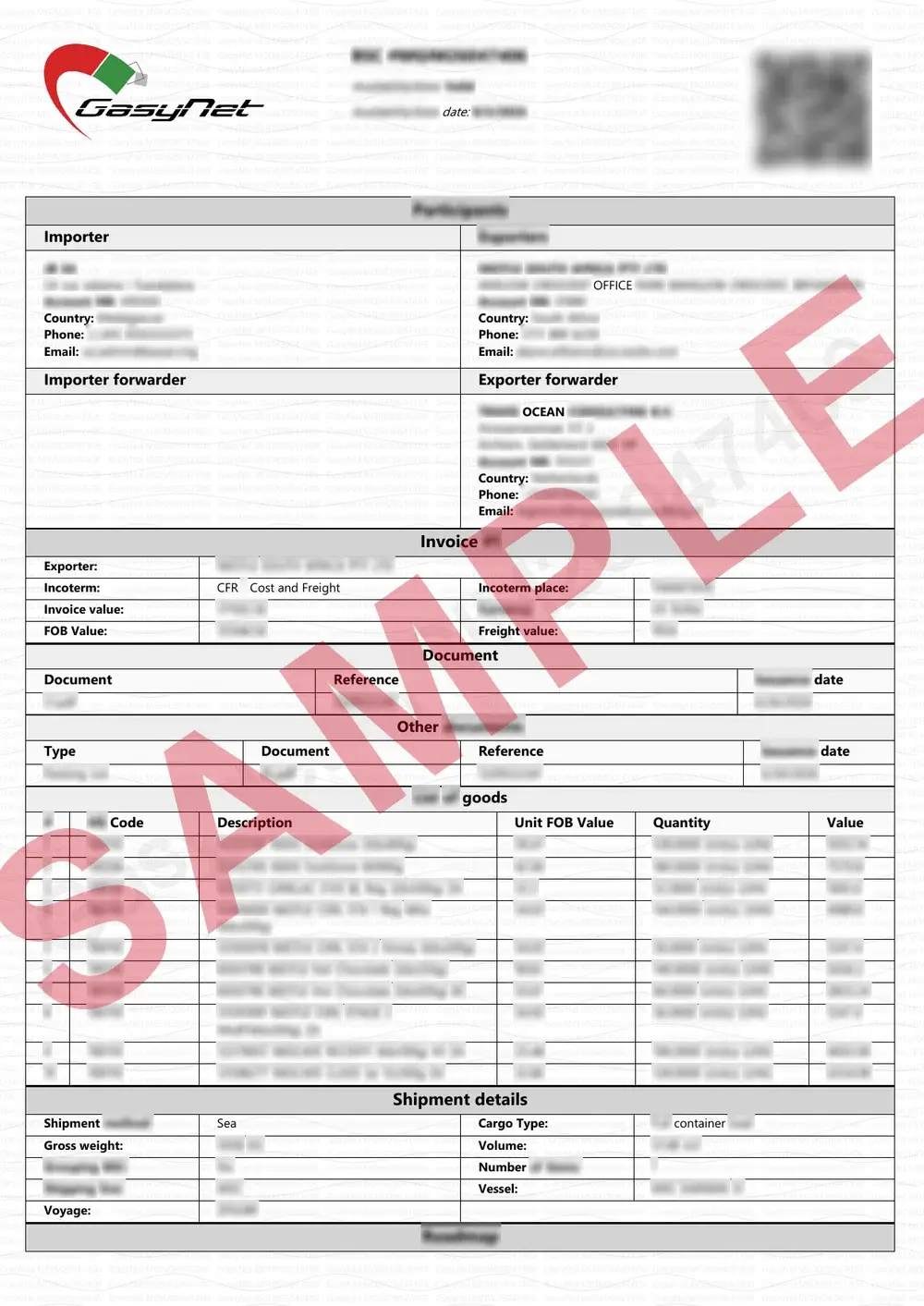
Official BSC Document Sample
Verify the layout, stamps, and BSC customs format of a validated Madagascar loading certificate: