

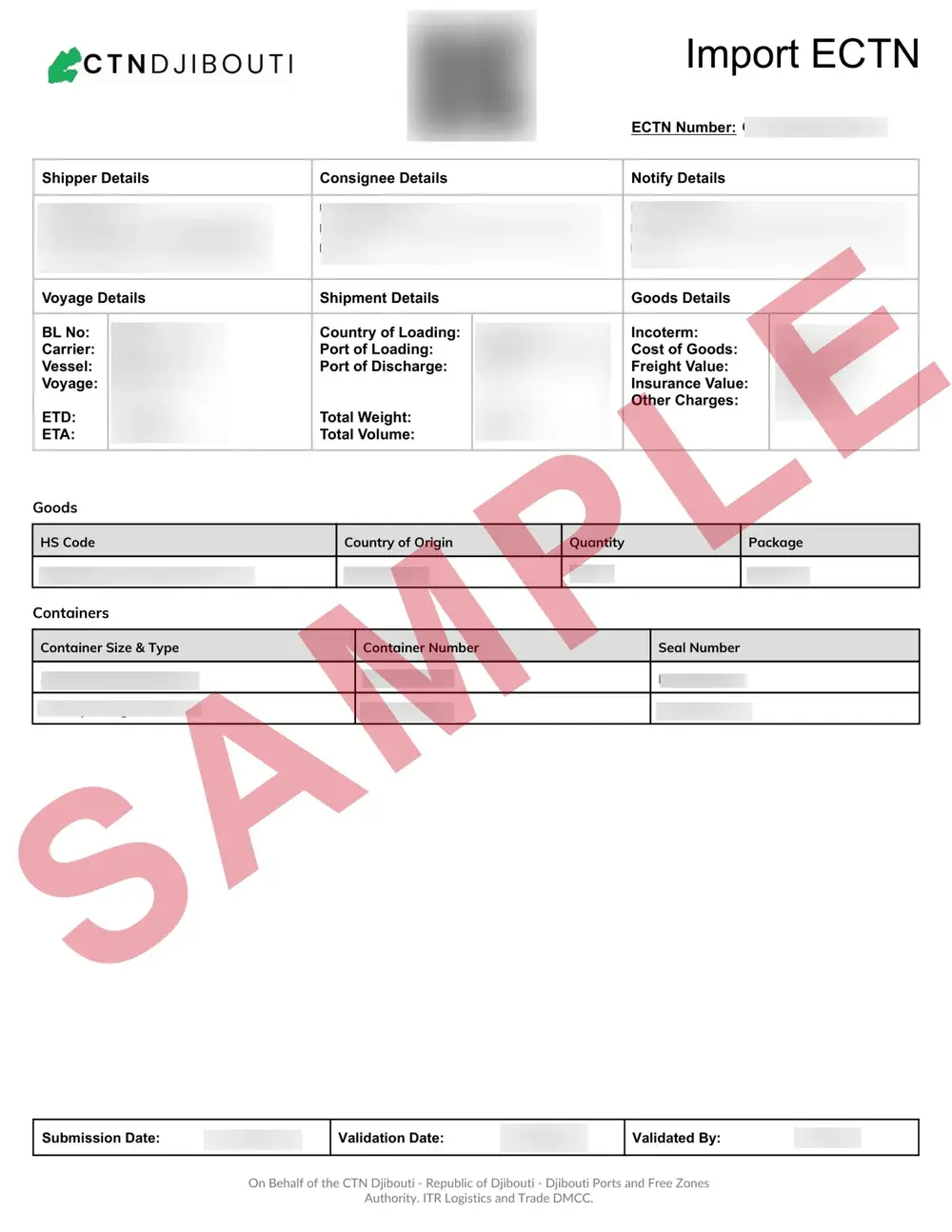













What is Djibouti ECTN?
The ECTN (Electronic Cargo Tracking Note) is a mandatory loading certificate for sea shipments discharging at the Port of Djibouti. Because Djibouti is the primary maritime gateway for landlocked Ethiopia, the ECTN is used by customs and the port authority to track cargo, shipper, consignee and declared values before the vessel arrives. Cargo in direct transit to Ethiopia is exempt when the Bill of Lading states “In transit to Ethiopia” and the consignee is in Ethiopia. The ECTN must be obtained at the port of loading by the shipper, the exporter or the freight forwarder. A missing, expired or incorrect ECTN at Djibouti typically causes customs clearance delays, storage and demurrage charges, and regulatory fines until a valid certificate is provided.
Which ports need the Djibouti ECTN?
The Djibouti ECTN covers containerized cargo unloaded at the Port of Djibouti and cargo entering the Djibouti Free Zone. Cargo in direct transit to Ethiopia, unloaded and immediately forwarded, is exempt if the Bill of Lading states “In transit to Ethiopia” and the consignee is in Ethiopia; cargo cleared in Djibouti still needs the ECTN.
Official Djibouti ECTN sources
The Djibouti ECTN is issued through the official CTN Djibouti platform.
accessed
When must the Djibouti ECTN be issued?
Obtain the Djibouti ECTN before the cargo reaches the port of discharge; the official platform recommends at least five days before the vessel leaves for Djibouti. A draft Bill of Lading is enough to start, but the final Bill of Lading must carry the ECTN number.
Who files the Djibouti ECTN?
The shipper, the exporter or the freight forwarder obtains the Djibouti ECTN at the port of loading. The consignee in Djibouti does not file it.
How to get the Djibouti ECTN, step by step
According to the customs regulations of Djibouti, every cargo shipment purchased from abroad and transported for commercial, business, diplomatic, or personal purposes requires a validated Loading Certificate:
- ▪The shipper or freight forwarder applies for the Djibouti ECTN before the cargo arrives, ideally before departure.
- ▪Prepare the Bill of Lading and Commercial Invoice for validation.
- ▪Our compliance desk cross-checks the shipper, consignee and cargo details against destination requirements.
- ▪The ECTN number must appear on the final Bill of Lading. Cargo in direct transit to Ethiopia is exempt when the Bill of Lading states “In transit to Ethiopia” and the consignee is in Ethiopia.
- ▪File early to avoid post-arrival penalties and demurrage at one of the region's busiest transit hubs.
Djibouti ECTN: validity and amendments
A validated ECTN is issued against one shipment: one Bill of Lading, one vessel, one voyage, one consignee. It does not carry over to your next shipment and it carries no renewal date. If the shipment changes, the certificate has to change with it — and what can be amended after validation, and at what cost, is set by the destination authority. Corrections to the draft before filing cost nothing, which is why we send you the draft first.
What happens without a valid Djibouti ECTN?
Cargo arriving without a validated ECTN is generally not released at Djibouti: customs clearance delays, storage and demurrage accruing daily, and regulatory fines until a valid certificate is presented. The demurrage is often the larger of the two numbers, and it is the one that grows while the paperwork is corrected.
What a Djibouti ECTN costs
Two lines, quoted separately. The first is the statutory charge the destination authority sets for registering the certificate — it belongs to the authority, not to us, and it varies by destination and shipment profile. The second is our service fee for preparing the file, checking it against the published requirements, filing it and handling any query. Neither is a percentage of your cargo value. Both are fixed and shown before anything is filed, so the invoice you approve is the invoice you pay.
Djibouti ECTN questions
What is the ECTN for Djibouti?
The Djibouti ECTN is a compulsory Electronic Cargo Tracking Note that records loading and invoice details so customs and the port authority can verify shipments before they arrive at the Port of Djibouti.
Do Ethiopia-bound shipments need a Djibouti ECTN?
Not if it is in direct transit. An ECTN is not required for cargo unloaded at Djibouti and immediately forwarded to Ethiopia, provided the Bill of Lading states “In transit to Ethiopia” and the consignee is in Ethiopia. Cargo cleared in Djibouti or entering the Djibouti Free Zone needs the ECTN.
Which documents are required for a Djibouti ECTN?
The core documents are the Bill of Lading and the Commercial Invoice. Additional paperwork may be requested during validation depending on the cargo.
When should the Djibouti ECTN be issued?
The exact cut-off depends on the destination, so we confirm it for your route, to avoid clearance delays at destination.
What happens if cargo arrives in Djibouti without an ECTN?
Cargo without a validated ECTN generally faces customs clearance delays, storage and demurrage charges, and fines until a valid certificate is presented.
Is the Djibouti CTN the same as the Djibouti ECTN?
Yes. CTN (Cargo Tracking Note) and ECTN (Electronic Cargo Tracking Note) are the same certificate for Djibouti; one is issued per Bill of Lading.
Since when is the Djibouti ECTN mandatory?
Since 15 June 2023, for all containerized shipments unloaded in Djibouti, including cargo for the Djibouti Free Zone.