
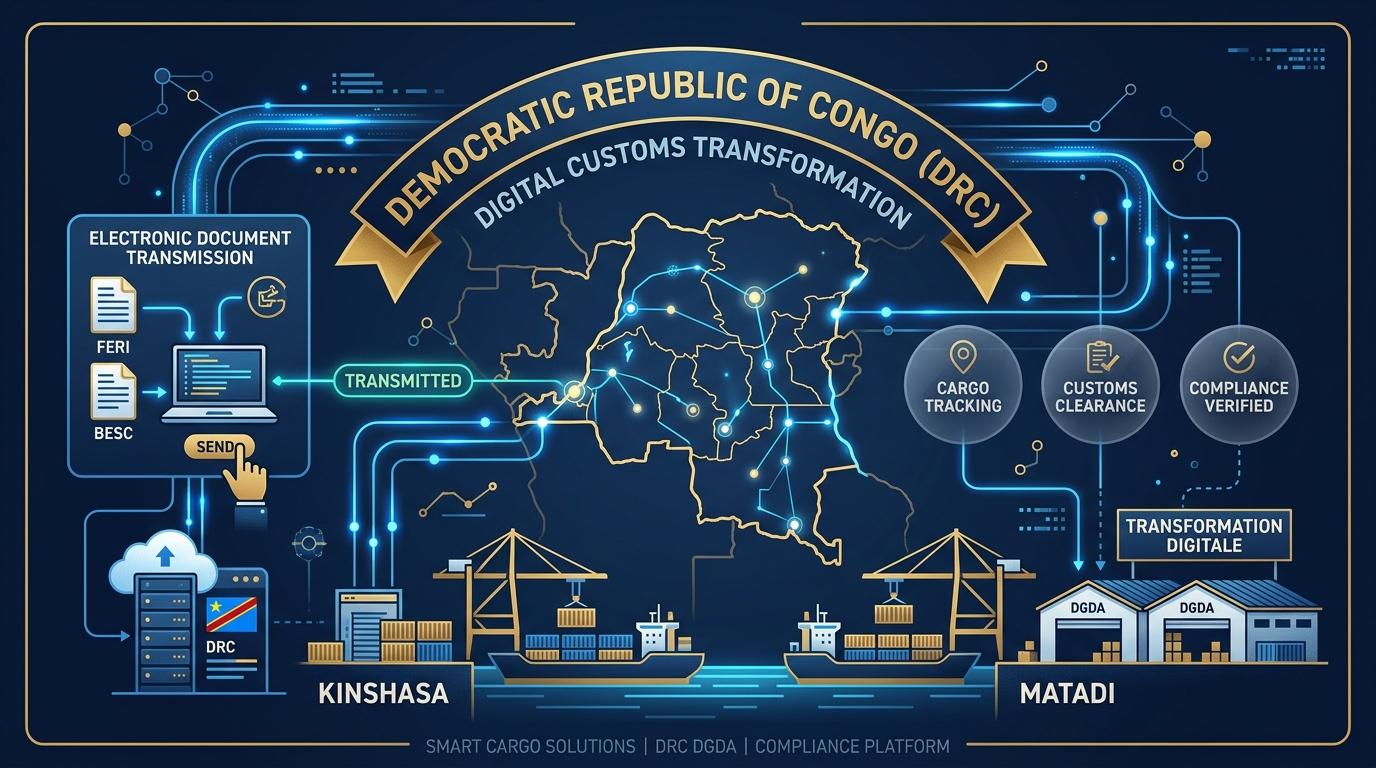
The New Standard for Trade Operations
According to the circular issued by the Ministry of Finance and the Ministry of Foreign Trade, all documentation related to import, export, and transit operations must now be transmitted exclusively via electronic means.
This process involves the seamless interfacing of two primary digital systems:
- S)ONE: The platform used by the Integrated Single Window for Foreign Trade (GUICE)
- SYDONIA WORLD: The computer system utilized by the DRC Customs (DGDA)
This integration ensures transparency, traceability, and the securing of public revenue throughout the pre-clearance, clearance, and post-clearance phases.
Implementation Timeline & Scope
The transition followed a phased deployment strategy to ensure system stability across the national territory.
| Period | Scope / Activity |
|---|---|
| Dec 29, 2025 | Official launch of the electronic transmission between GUICE and Customs |
| Dec 29, 2025 – Jan 15, 2026 | Pilot phase in Kinshasa-Ville and Kinshasa-Aéroport |
| Jan 15 – Jan 31, 2026 | Deployment in the Provinces of Haut-Katanga and Lualaba |
| Feb 1 – Feb 15, 2026 | Deployment in the Kongo-Central Province |
| From Feb 18, 2026 | Full National Generalization: Mandatory electronic transmission across the entire DRC |
Legal Compliance and Enforcement
Economic operators must be aware that this is no longer optional. Under the new regulations:
- Mandatory Use: Public services and economic operators are strictly required to use dematerialized documents
- Irregular Operations: Any trade operation conducted outside the official GUICE channel is now deemed irregular
- Sanctions: Non-compliance is classified as administrative malpractice or an economic crime, exposing involved parties to disciplinary and judicial sanctions
Why This Matters
This initiative stems from the DRC's commitment to international standards, specifically the WTO Trade Facilitation Agreement ratified via Ordinance-Law No. 25/037. By removing physical paperwork, the DRC aims to reduce delays, lower the cost of doing business, and align with global digital trade trends.