
Kenya ACD
ACD is a mandatory document for all containerized shipments to Kenya
We have many exporters who regularly obtain ACD for Kenya from us. Our exceptional team is ready to support exporters and freight forwarders in 24/7. Contact us now for a free consultation.
 +1 518 302 6818
 +91 91037 47061
 +55 81 98217 2334
 +31 970 1025 5535
 +44 7723 465323
 +971 4230 6314
 +966 566050151
 +92 333 4243 989
 +20 109 400 1060
 +8801568993034
 +601127856558
200+ customers per month. Clients from 30+ countries. 24/7 Support - Pay in Local Currency. All responsibility is ours. Contact us through the form.

Here are some of the companies we work with
We’ve provided the CTN certificate for over 20 countries to clients worldwide since 2005.






What Is a Kenya ACD Certificate?
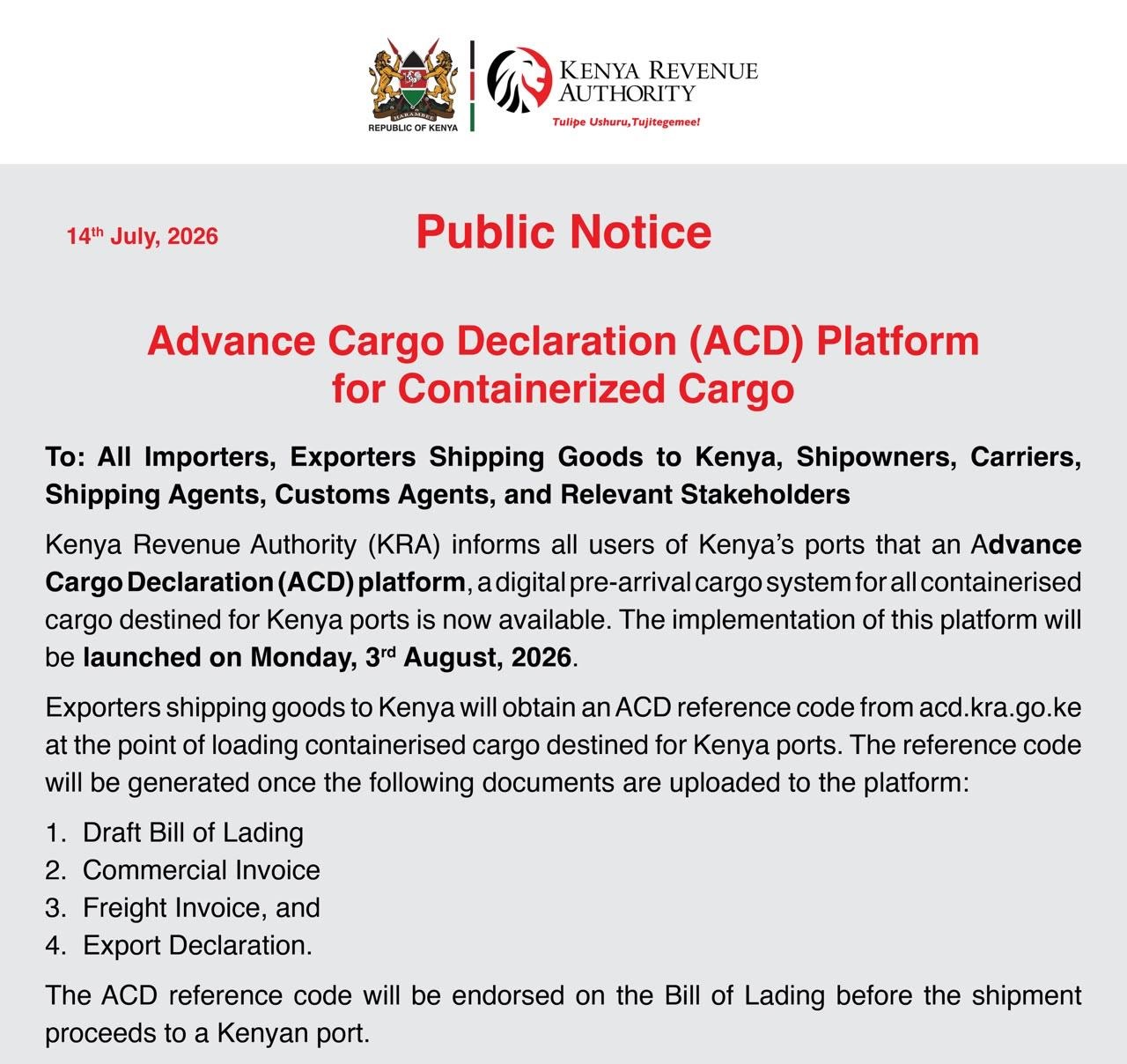
The Advance Cargo Declaration, commonly known as an ACD, is a mandatory loading document used to provide Kenya Customs with detailed shipment information before cargo arrives at a Kenyan port.
It is also associated with cargo declaration terms used in other countries, including:
- CTN — Cargo Tracking Note
- ECTN — Electronic Cargo Tracking Note
- BSC — Bordereau de Suivi des Cargaisons
- BESC — Bordereau Électronique de Suivi des Cargaisons
The declaration contains information about the cargo, exporter, importer, vessel, voyage, containers, ports, freight, and supporting commercial documents.
According to the Kenya Revenue Authority, the declaration must accompany shipments unloaded in Kenya, including cargo whose final destination is outside Kenya.
The Kenya ACD system helps Customs review shipments before arrival, track incoming cargo, improve supply-chain transparency, and support faster clearance at the destination port.





Procedure
According to this law, every cargo purchased from abroad and transported for commercial, business, in some cases, diplomatic and personal purposes require a Loading Certificate called ACD.
The shipper, exporter, or freight forwarder is responsible for acquiring the ACD waiver certificate from the authorized representative.

- Bill of Lading
- Commercial Invoice
- Freight Invoice
- Export Declaration
- The ACD must be obtained at the port of loading.
- The shipper is responsible for arranging the declaration.
- A validated declaration is required for shipments unloaded at Kenyan ports.
- The ACD reference code must be added to all applicable Bills of Lading.
- The declaration must be validated at least five days before the vessel arrives.
- Submitted documents must be clear and readable.
- Every shipment must have its own valid declaration and reference.
- Shipment information must correspond with the Bill of Lading and supporting commercial documents.
- Corrections should be completed before final validation whenever possible.
Failure to obtain the required ACD may result in fines, shipment delays, cargo rejection, or additional enforcement action. Serious cases may result in seizure or confiscation.
FAQs related to Kenya ACD Certificate
The Kenya Revenue Authority announced the implementation of the Advance Cargo Declaration for containerized cargo destined for Kenyan ports from:
3 August 2026
Shippers should prepare their procedures before the implementation date and ensure the ACD reference is obtained before the cargo proceeds to Kenya.
No. The ACD reference is linked to a specific shipment and its supporting documentation.
A new declaration should be obtained for each separate shipment.
The official procedure requires the ACD to be obtained at the port of loading. Applying after departure may create compliance and documentation problems.
Contact our operations team immediately when dealing with a sailed shipment.
The application and declaration process is managed electronically. A hardcopy is not required.
Keep the validated reference and related shipment records available for the carrier, consignee, clearing agent, and Customs process.
Regulatory Compliance
The declaration helps ensure cargo entering or being unloaded in Kenya complies with Customs requirements.
Advance Cargo Tracking
Kenya Customs can review and track shipment information before the vessel arrives.
Supply-Chain Transparency
Cargo, exporter, importer, vessel, and container information can be checked across the shipment process.
Faster Customs Processing
Submitting accurate information before arrival can support smoother cargo assessment and clearance.
Fraud and Risk Prevention
Advance declarations help authorities identify inconsistencies, incorrect documentation, prohibited cargo, and other potential risks before the goods reach the port.
The officials state that every shipment unloaded at a Kenyan port must be covered by a validated declaration, regardless of its final destination.
The initial launch notice specifically addresses containerized cargo destined for Kenyan ports.
Cargo unloaded at a Kenyan port may require an ACD even when another country is its final destination.
You should begin the application once the Draft Bill of Lading and supporting commercial documents are available.
Do not wait until the vessel has arrived. The ACD must be obtained at the port of loading.
The ACD reference code must be added to all applicable Bills of Lading.
Applicants should ensure the carrier or document-issuing party receives the validated reference before the Bill of Lading is finalized.
Non-compliance may result in:
- Customs delays
- Cargo holds
- Additional costs
- Fines
- Rejection at the port
- Enforcement action
- Seizure or confiscation in serious cases
General FAQs
GetCTN is an independent consulting firm that helps clients obtain CTN certificates in many African countries. It is an international company with offices in the USA, UK, and UAE, and its sole business is CTN certification; it is not a freight forwarder, importer, or exporter.
Yes. The documents can be submitted electronically, and our team can communicate with you through email, telephone, WhatsApp, or live chat.
There is no need to visit a physical office.
One of the main problems that the ECTN solves in West Africa shipping is the problem of document fraud. Document fraud is the use of falsified or fraudulent documents to facilitate illegal trade. This can include the use of fake bills of lading, invoices, or other shipping documents. Document fraud can lead to customs violations, financial losses, and other problems.