

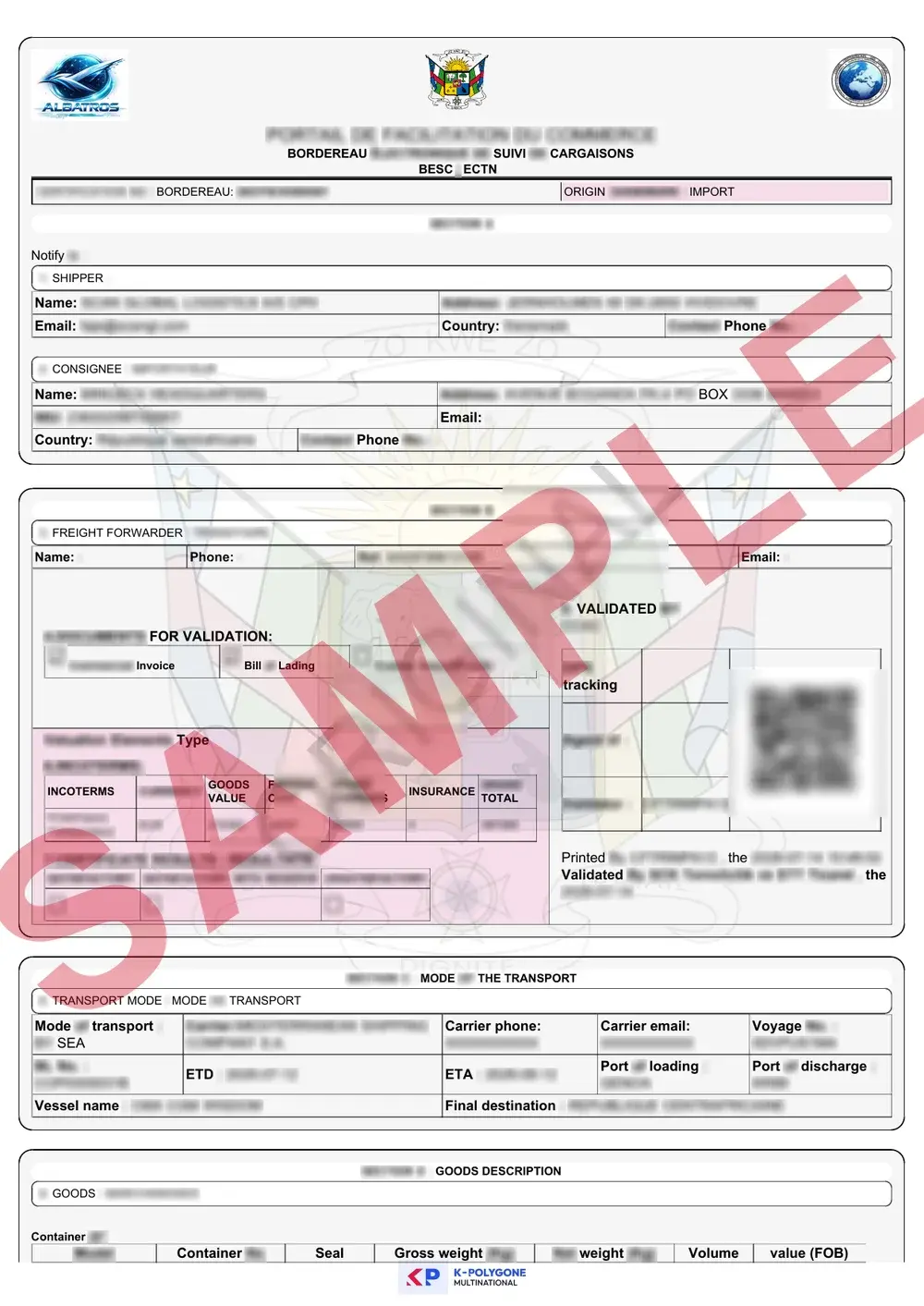














What is the Central African Republic ECTN (BESC)?
The BESC is the Central African Republic’s electronic cargo tracking note, run online by ANTASER under its arrangement with the authorities since 27 February 2012. A customs circular of 16 December 2016 made the rule explicit: a regularisation BESC issued at a transit port is strictly prohibited, only a BESC issued at the port of loading is accepted, and cargo arriving without one stays at the port of discharge until it is regularised online, with fines. In July 2026 a court judgment of 15 July restored ANTASER’s right to carry on the BESC activity for the Central African Republic. The BESC must now also carry the NIU of the importer or the exporter.
New to the BESC? Read BESC meaning, and CTN meaning in shipping for the cargo tracking note that 30 African and Middle East destinations ask for in one form or another.
Other names for the Central African Republic BESC
One instrument, several names. For Central African Republic the filing is the BESC — Bordereau Électronique de Suivi des Cargaisons. The same certificate is also referred to as ECTN (Electronic Cargo Tracking Note), and BESC Centrafrique, and a request for one is a request for the other. If your importer or your carrier has asked for a name that is not on this page, send it to us with the Bill of Lading and we will confirm which filing they mean.
Central African Republic ECTN: transit via Douala, Kribi and Pointe-Noire
The Central African Republic has no seaport. Its sea cargo is discharged mainly at Douala or Kribi in Cameroon, or at Pointe-Noire in Congo, and continues by road to Bangui. The BESC follows the final destination: any Bill of Lading for the Central African Republic needs the Central African Republic BESC, whichever coastal port is used. On the Cameroon route, the Cameroonian BESC for transit cargo has been suspended since 15 June 2026 until further notice (CNCC communiqué); the Central African Republic BESC is still required.
Central African Republic BESC: official notices
The BESC for the Central African Republic is run by ANTASER, which publishes the customs circulars and notices for the country.
accessed
When to file the Central African Republic BESC
The BESC is issued at the port of loading, so file it before the cargo is loaded. A BESC cannot be obtained later at a transit port: the 2016 customs circular prohibits regularisation BESCs there, and cargo without a BESC waits at the port of discharge, with storage and fines, until it is regularised online.
Who files the Central African Republic BESC
The shipper, the exporter or the freight forwarder at origin files the BESC. The importer in the Central African Republic does not file it, but its NIU must appear on the application for an import shipment.
How to get the Central African Republic BESC, step by step
According to the customs regulations of Central African Republic, every cargo shipment purchased from abroad and transported for commercial, business, diplomatic, or personal purposes requires a validated Loading Certificate:
- ▪Send the Bill of Lading, the commercial invoice, the freight invoice and the export declaration, with the port of discharge and the final destination in the Central African Republic.
- ▪Give us the NIU: the importer’s for an import, the exporter’s for an export. A BESC cannot be validated without it.
- ▪We check that parties, addresses, weights and values match across the documents, and send you the draft. The BESC number is issued at validation.
- ▪The BESC is validated at the port of loading, before the cargo loads, and travels with the shipment to the Central African Republic.
Central African Republic BESC: validity and amendments
A validated BESC is issued against one shipment: one Bill of Lading, one vessel, one voyage, one consignee. It does not carry over to your next shipment and it carries no renewal date. If the shipment changes, the certificate has to change with it — and what can be amended after validation, and at what cost, is set by the destination authority. Corrections to the draft before filing cost nothing, which is why we send you the draft first.
What happens without a valid Central African Republic BESC?
Cargo arriving without a validated BESC is generally not released at Douala (Cameroon), Pointe-Noire (Congo) or Matadi (DR Congo): customs clearance delays, storage and demurrage accruing daily, and regulatory fines until a valid certificate is presented. The demurrage is often the larger of the two numbers, and it is the one that grows while the paperwork is corrected.
What a Central African Republic BESC costs
Two lines, quoted separately. The first is the statutory charge the destination authority sets for registering the certificate — it belongs to the authority, not to us, and it varies by destination and shipment profile. The second is our service fee for preparing the file, checking it against the published requirements, filing it and handling any query. Neither is a percentage of your cargo value. Both are fixed and shown before anything is filed, so the invoice you approve is the invoice you pay.
Central African Republic ECTN and BESC questions
What is the Central African Republic BESC?
The BESC is a compulsory Electronic Cargo Tracking Note (ECTN) for shipments to Central African Republic. It records loading and invoice details so customs can verify compliance ahead of the destination's filing deadline.
Which documents are required to obtain the BESC?
The core documents are: Bill of Lading, Commercial Invoice, Packing List, Freight Invoice, and Export Customs Declaration. Additional destination-specific paperwork may be requested during validation — our desk confirms the exact list for your shipment.
When must the BESC be issued?
The BESC is issued at the port of loading, so file it before the cargo is loaded. A BESC cannot be obtained later at a transit port: the 2016 customs circular prohibits regularisation BESCs there, and cargo without a BESC waits at the port of discharge, with storage and fines, until it is regularised online.
What happens if cargo arrives without a valid BESC?
The BESC cannot be obtained later at a transit port: the customs circular of 16 December 2016 prohibits regularisation BESCs there, so cargo for Bangui without a BESC waits at the port of discharge.
Can a validated BESC be modified after issuance?
Once validated, changes are generally restricted. Ensure all weights, values and party details match your cargo manifests and Bill of Lading exactly before submitting.
What is the NIU on the Central African Republic BESC?
The NIU (Numéro d’Identification Unique) is the unique identification number of the trader. It is now a mandatory field on the BESC application and on the validated BESC: the importer’s NIU for an import shipment, the exporter’s NIU for an export. A BESC that was validated before the change but has not yet been checked at destination has to be updated with the NIU.
Can the Central African Republic BESC be obtained at Douala or another transit port?
No. A customs circular of 16 December 2016 prohibits issuing a regularisation BESC at a transit port; only a BESC issued at the port of loading is accepted. Cargo without one stays at the port of discharge until it is regularised online, with fines.
Who runs the Central African Republic BESC?
ANTASER runs the online BESC for the Central African Republic, where it has been operational since 27 February 2012. A court judgment of 15 July 2026 restored ANTASER’s right to carry on the activity.
Is the Central African Republic ECTN the same as the BESC?
Yes. Searches for the Central African Republic ECTN mean the BESC, the name printed on the certificate.
Do I need a Central African Republic ECTN for cargo discharged at Douala or Pointe-Noire?
Yes. The Central African Republic ECTN follows the final destination, not the port: cargo for Bangui discharged at Douala, Kribi or Pointe-Noire needs the Central African Republic ECTN, issued as the BESC at the port of loading. Whether the transit country also asks for its own certificate depends on the port; tell us the port of discharge with the Bill of Lading.